LAL vs PanOptix Pro: Adjustable or Trifocal?
Published August 20, 2026 · Updated September 21, 2026 · Medically reviewed by Todd Driver, MD
Quick answer: If you want the greatest range of focus in each eye, nothing beats a trifocal like the PanOptix Pro by design, but the rings that create that range produce some glare and halo around lights at night. The Light Adjustable Lens (I implant the newer LAL+) has no rings and is the only lens that can be adjusted after surgery. Its published accuracy runs around 93 to 94% within half a diopter of target, about half a step of a glasses prescription, versus roughly 80% for conventional lenses, though those numbers come from separate studies rather than a head-to-head. Range versus adjustability is the real decision.
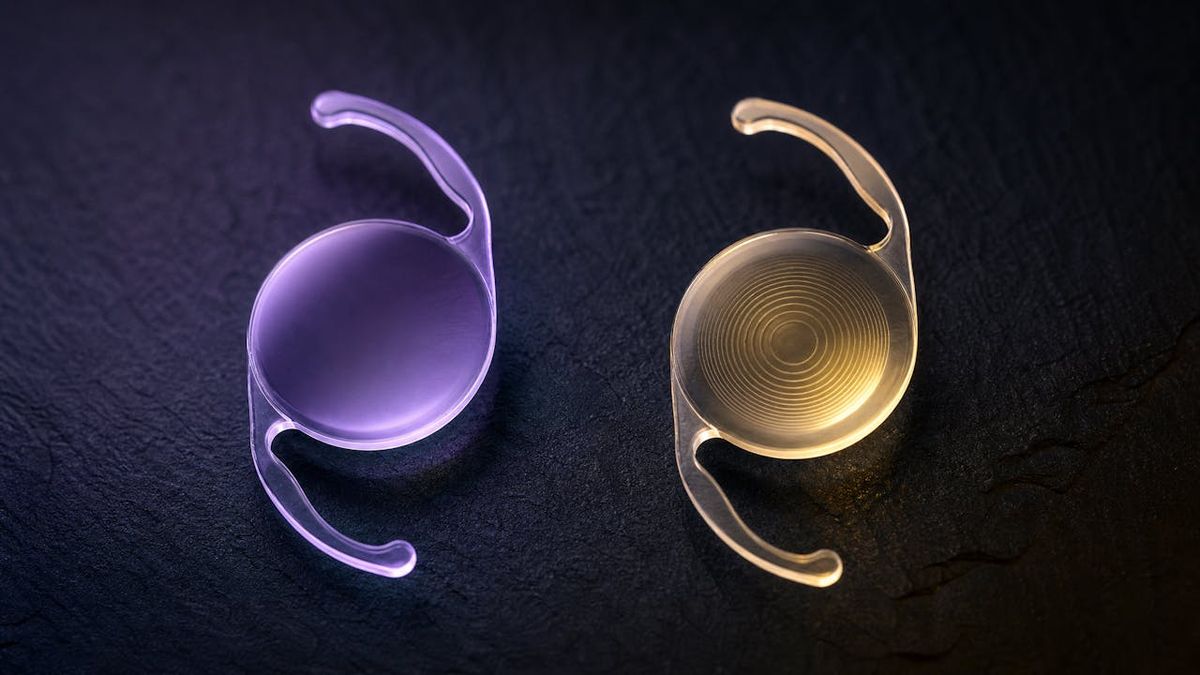
You've decided you want less dependence on glasses after cataract surgery, and now you've hit the real question: "Doc, should I get the trifocal or the adjustable lens?" So here is the conversation I have in the exam room.
What I tell my patients about the trifocal
If you want the greatest range of focus in each eye, nothing beats a trifocal lens by design. That's the PanOptix family, and the same goes for the other lenses in this class, like the Bausch + Lomb enVista Envy and the Johnson & Johnson TECNIS Odyssey. Distance, arm's length, and reading are all built into the lens from day one. That's the tri in trifocal.
So how do they give you all that range? They have to put rings in the lens, kind of like a target etched into the lens, and those rings split the incoming light. That splitting gives you a little bit of glare and halo around lights at nighttime. Compared to the older generations of these lenses, the glare and halos are much less. But there will be some.
I've compared the two newest trifocal-class lenses in detail in enVista Envy vs PanOptix Pro if that's the decision you're weighing.
The LAL+ side of the conversation
The LAL+ is a great lens. Its range of focus isn't quite as big as the PanOptix Pro's, and I say that out loud too. But we can get around a lot of that gap by using mini monovision during the adjustments after surgery, with one eye tuned for distance and the other nudged slightly nearer. In the LAL+ registry, 89% of patients ended up choosing some form of blended vision, which is what we call that setup, and they chose it after trying it, kind of like test-driving the prescription before you commit. Not everyone likes blended vision, and that is exactly why the adjustments matter. You try it first, and if you don't like it, we adjust back before anything is locked in.
Because there are no rings, there's nothing in the lens to split light. The optical clarity on this lens is amazing, and in my practice I don't really hear complaints about glare and halos around lights at nighttime. If you've read my article on the LAL vs the LAL+, you know the version I use and why.
The accuracy numbers
The main advantage of the LAL+ is the adjustability after surgery.
With conventional lenses, we choose the power before surgery using formulas, and in the operating room I double-check that choice with a device called ORA. In the largest published formula study, about 80% of eyes landed within half a diopter of target.
With the LAL+, we don't predict. We adjust after your eye has healed, with your real prescription in front of us. In the LAL+ registry, 93.5% of eyes landed within half a diopter, and a second registry of over 2,000 eyes found 94.3% of the distance-targeted eyes did. Those numbers come from different studies on different patients, so it's not a perfect comparison. It's still a real gap.
Leftover prescription is one of the most common reasons patients end up unhappy after trifocal and EDOF (extended depth of focus) lenses in published series, and it's the most preventable one. That's consistent with my experience as well. When a trifocal lands off target, the ways to fix it are glasses, a lens exchange, which I think is risky and never recommend, or a corneal laser procedure like LASIK or PRK after the surgery. With the LAL+, we just adjust it.
So which one fits you?
The PanOptix Pro or another trifocal is a really good option if you want the greatest range of focus in each eye, if you don't want to commit to the adjustment visits (which are a real time commitment after LAL surgery), or if you're not a candidate for the adjustable lens in the first place, for example with a prior history of ocular herpes (a herpes infection in the eye) or medications that increase UV sensitivity.
I lean toward the LAL+ when precision is the priority. If you've had LASIK, PRK, or RK (the older radial keratotomy) before, if your measurements make the formulas less trustworthy, if night driving matters a lot to you, or if you're the kind of person who wants a say in the final result, that's the direction I usually point. It's the only lens I can fix after surgery without going back to the operating room.
Neither answer is wrong. Both lenses make most of their patients very happy; the difference is which trade-off fits your life.
Side by side
| PanOptix Pro (trifocal) | LAL+ (adjustable) | |
|---|---|---|
| How the range is made | Rings split light into set focal points | Smooth surface; slight built-in depth of focus, then blended vision tuned during adjustments |
| Range of focus | Biggest by design: distance, intermediate, near in each eye | Distance and intermediate strong; near usually via mini monovision |
| Night glare and halos | Present but reduced versus older trifocals | No ring-related halos; clarity is the design's strength |
| On-target accuracy (±0.5 D) | Conventional prediction; about 80% published with modern formulas | 93.5% and 94.3% in the two published registries (separate studies, not head-to-head) |
| If the target is missed | Glasses, corneal laser touch-up, or lens exchange | Adjusted in the office with light treatments |
| After-surgery commitment | Standard follow-ups | Adjustment visits plus two lock-ins, with UV glasses in between |
| Not a fit if | Significant retinal disease, high halo sensitivity | UV-sensitizing meds, ocular herpes history, poor dilation, can't do the visits |
Common questions
Which lens gives better reading vision?
The trifocal, in each eye on its own. That's what the rings are for. The LAL+ usually gets to functional reading through mini monovision set during your adjustments, and in the registry 89% of patients chose a blended setup.
Does the LAL+ cause halos like the PanOptix Pro?
The LAL+ has no rings, which are the main source of trifocal halos, and in my practice halo complaints with it are rare. No published study has directly compared night symptoms between these two lenses, and any lens can produce some night-vision changes, so bring your night-driving habits to your consultation.
What happens if a trifocal lens misses the target?
The options are glasses, a corneal laser procedure like LASIK or PRK, or a lens exchange, which I think is risky and never recommend. That's the scenario the adjustable lens was designed to avoid. A missed target on the LAL+ gets adjusted in the office.
Can I get the trifocal's range without the rings?
Not fully, in a single eye. The rings are what create the full built-in range. The LAL+ closes much of the gap with blended vision across your two eyes, tuned after surgery.
Sources: Doane et al., clinical data registry comparing outcomes of two light adjustable lenses (J Cataract Refract Surg 2025) · Schallhorn et al., Phase IV clinical registry of 2,202 bilaterally implanted LAL eyes (2026) · Melles et al., IOL formula accuracy in 18,501 eyes (Ophthalmology 2018) · Raufi et al., intraoperative aberrometry vs Barrett Universal II (J Cataract Refract Surg 2020) · American Academy of Ophthalmology technology assessment of intraoperative aberrometry (Ophthalmology 2025) · Woodward et al., dissatisfaction after multifocal IOL implantation (J Cataract Refract Surg 2009) · Gibbons et al., causes and correction of dissatisfaction after presbyopia-correcting IOLs (Clin Ophthalmol 2016) · Alcon Clareon PanOptix Pro professional page · FDA premarket approval P160055 (LAL platform)
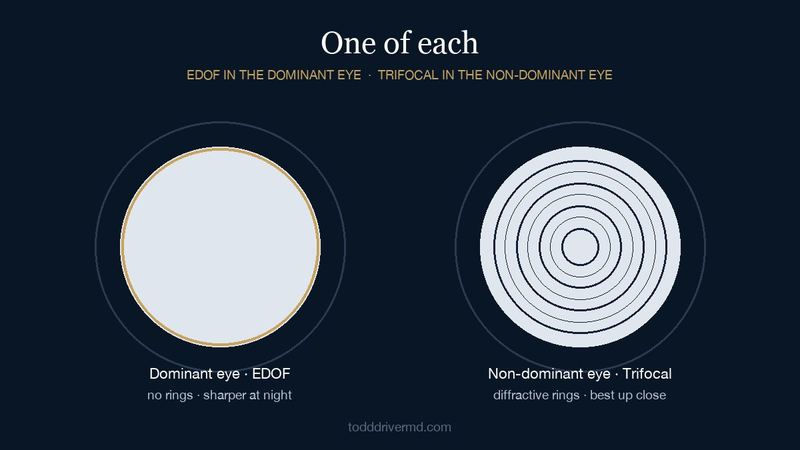
Related reading: Light Adjustable Lens vs Vivity · Odyssey vs PanOptix Pro · a trifocal in one eye and an EDOF in the other · Is the LAL worth the cost? · LAL vs LAL+: what changed · enVista Envy vs PanOptix Pro · The Light Adjustable Lens, explained · Who should not get a multifocal lens · Is ORA worth it? · or the Light Adjustable Lens in Irvine.
Two tools that may help you think this through: the 60-second lens quiz, and the vision simulator, which shows how each lens sees by day and at night.
Adjustable or trifocal for your eyes?
Hopefully this makes the trifocal-versus-adjustable decision clearer. Which one fits your eyes takes a consultation. OC Eye Associates, Irvine.
Call (949) 653-9500Read next

This article is for educational purposes and is not a substitute for a medical examination or personalized medical advice. Lens choice is always individualized at your own consultation.