enVista Envy vs PanOptix Pro: A Cataract Surgeon Compares the Data
Published August 19, 2026 · Medically reviewed by Todd Driver, MD
Quick answer: The enVista Envy and the PanOptix Pro are two of the newer full range of vision lens implants available in the United States: lenses designed to give you distance, arm's length, and near vision in the same eye. No head-to-head study comparing them exists, so anyone who tells you one is better than the other is comparing numbers from different studies that asked different questions. Below is what each lens's own data shows, where the numbers come from, and how I decide between them in my clinic.
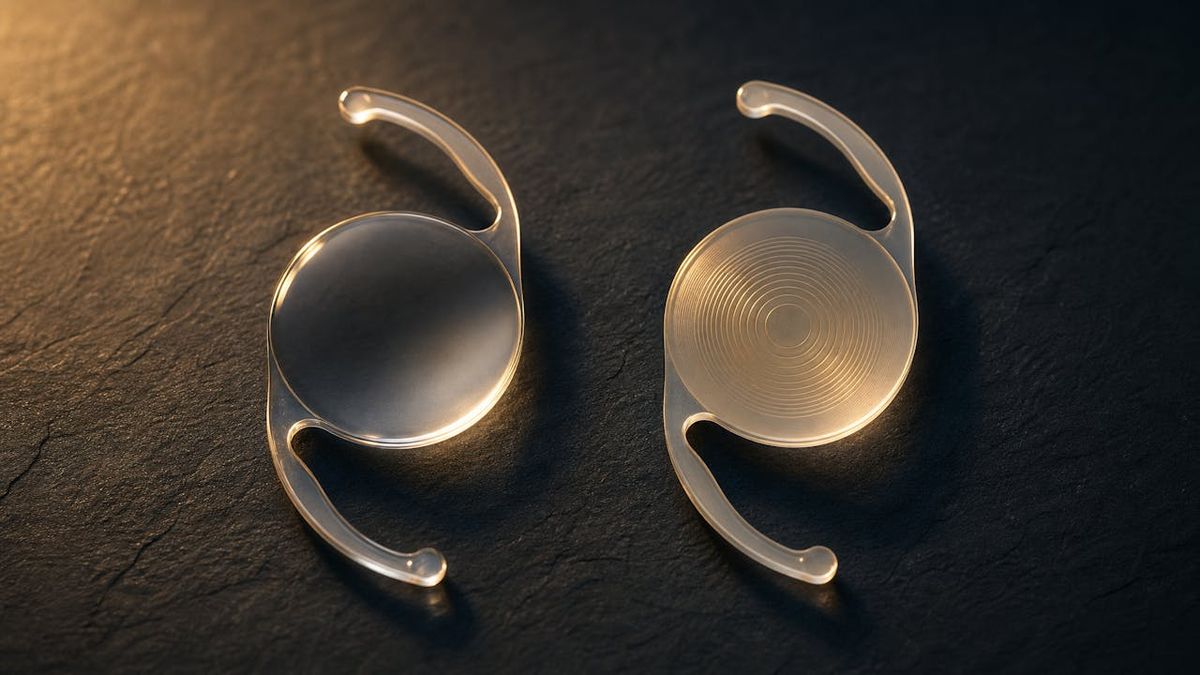
So, some context. I'm a cataract surgeon in Irvine, California, and I offer both lenses. I've implanted the PanOptix family for years. The Envy is newer to my operating room, and I'll say more about that below. One rule before any numbers: each lens's figures come from its own studies, measured on different scales, and they cannot be lined up against each other. Keep that in your pocket. I'll come back to it.
How the PanOptix Pro works
The PanOptix Pro is Alcon's update of the original PanOptix, a trifocal lens that has been in wide use for years. Like the original, it splits incoming light into three focus points: distance, intermediate, and near. Splitting light buys you the range, and it also created the old trade-off. Light that doesn't land on a focus point scatters, and scattered light is what you see as rings and halos around headlights at night, kind of like a fingerprint on a camera lens turning points of light into glow.
The Pro's redesign goes after that scatter. On Alcon's optical bench testing, the Pro directs 94% of incoming light to its focus points, up from 88% in the original, which cuts the scattered portion roughly in half. And I want you to know what kind of number that is: it comes from measuring the lens in a lab, not from surveying patients. The peer-reviewed patient data on the Pro itself (how often Pro patients see halos, and how bothered they are) hasn't been published yet as I write this.
The patient data we do have belongs to the original PanOptix. Across a meta-analysis of 11 studies covering 580 patients, the share of patients bothered "very much" ranged from about 1 in 100 for glare to about 3 in 100 for starbursts. In a separate questionnaire study of 127 patients, 99.2% said they would choose the same lens again. The Pro is expected to match or improve on those numbers; expected is not the same as shown.
How the enVista Envy works
The Envy is Bausch + Lomb's full range of vision lens, built on their enVista platform and FDA approved in October 2024. It's a trifocal-style optic with a twist: it adapts how it distributes light as your pupil changes size, shifting more light toward distance in dim conditions, which is aimed squarely at the nighttime halo problem. Distance vision is comparable to a standard single-focus lens. In daily terms, the range covers the road and the TV, the dashboard and the laptop, and most phone and menu print. Small print in a dim restaurant is the weak end of the range for every lens in this category, this one included.
The Envy arrived with patient-reported results. In its U.S. trial of 332 patients, 86% reported little to no bother from glare, halos, or starbursts. Earlier Canadian data found 94% of patients had little or no difficulty seeing close objects, and 93% were at least moderately satisfied with their vision. Notice the wording on that last one: "moderately satisfied" counts toward the 93%. Questionnaire scales are generous to every lens, which is one more reason to hold all of these numbers loosely.
The Envy has caveats of its own. Its track record is short: one U.S. trial plus that Canadian data, against years of accumulated studies on the PanOptix platform. And 86% reporting little to no bother also means roughly one patient in seven reported something more than a little. On the practical side, its astigmatism-correcting (toric) version comes in 0.5 diopter steps (a diopter is the unit of focusing power; small steps let the correction sit close to your cornea's exact number).
| enVista Envy | PanOptix Pro | |
|---|---|---|
| Maker and design | Bausch + Lomb; trifocal-style optic that adapts light distribution to pupil size | Alcon; trifocal with redesigned optics to cut light scatter |
| U.S. FDA approval | October 2024 | 2025 |
| Patient-reported data | U.S. trial of 332 patients; earlier Canadian data | Not yet published for the Pro; the original PanOptix has years of studies |
| Night vision evidence | 86% reported little to no bother from glare, halos, or starbursts (U.S. trial) | Bench testing: 94% light utilization, roughly half the scatter of the original |
| Satisfaction | 93% at least moderately satisfied (Canadian data) | 99.2% would choose the same lens again (original PanOptix, 127 patients) |
| Astigmatism correction | Toric version in 0.5 diopter steps | Toric options in the PanOptix family |
| Insurance | Out-of-pocket upgrade | Out-of-pocket upgrade |
Scroll the table sideways to see every column.
Why you can't line these numbers up
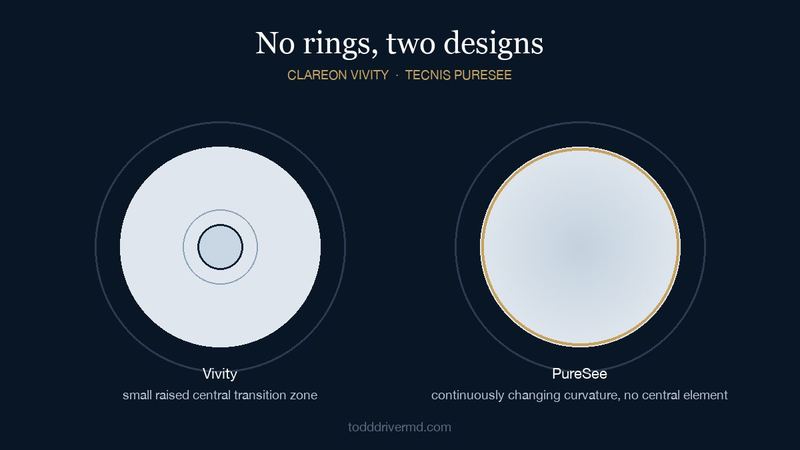
Here's the mistake people make with these numbers. You might see 86% "little to no bother" for the Envy next to "1 to 3 in 100 bothered very much" for PanOptix and conclude PanOptix wins night vision by a mile. But those are opposite ends of different rulers: different studies, different patients, different questionnaires. Read honestly, both datasets say roughly the same thing. Most patients do well at night with these lenses, a minority notice halos, and a small group stays bothered. Nothing published says one lens beats the other, because that study hasn't been run. When head-to-head data appears, I'll update this post. Until then I hold all of these numbers loosely, the same way I hold the Vivity and PureSee studies loosely.
What if you end up in the bothered minority?
So, what happens if you're the one in seven who notices more than a little glare or halo, or in the smaller group still bothered months later? Usually, time. Halos tend to fade over weeks to months as your brain adapts to the new optics; doctors call it neuroadaptation. If they don't fade, there are real options: glasses tuned for night driving, a laser touch-up if a small leftover prescription is amplifying the glare, and in uncommon cases the lens can be exchanged. A lens implant is meant to be permanent, but you are not stuck in the rare case where it truly isn't working. Ask your surgeon, before surgery, how they handle an unhappy multifocal patient. The answer tells you a lot. And some eyes shouldn't get a lens in this category at all; I wrote separately about who should not get a multifocal or EDOF lens, and it applies to both of these.
Do they cost the same?
Neither lens is covered by insurance. Both are premium, out-of-pocket upgrades over a standard lens implant, and pricing varies by practice, so ask for exact numbers up front. At my office, we go through pricing at the consultation, before you decide anything.
So, here's the bottom line
Both of these lenses were built to answer the same complaint: the halos that made a generation of patients hesitate about lenses like these. Both sets of numbers are encouraging, and no published study crowns either one. What predicts your happiness a year from now is not the brand of the lens. It's whether your surgeon measured your cornea carefully, examined your retina and the surface of your eye, asked how you spend your day, and told you the truth about the trade-offs.
If you're weighing lens options, the lens simulator and lens quiz on this site are a good next step, along with my full comparison of the premium lens categories, including the extended range (EDOF) lenses and the Light Adjustable Lens. These lenses come up both in cataract surgery and in refractive lens exchange, the same operation done before a cataract forms. And if you're in Orange County: OC Eye Associates, Irvine, (949) 653-9500. Bring your questions.
Related reading: Odyssey vs PanOptix Pro · LAL vs PanOptix Pro: adjustable or trifocal? · comparing all the premium lens categories · Vivity vs PureSee compared · who should not get a multifocal lens · all four lens choices explained · or call to arrange a cataract consultation in Irvine.
Two interactive tools can help you compare your options: take the 60-second lens quiz or see each lens in the vision simulator, day and night.
Weighing these two lenses for your own eyes?
That's exactly what a consultation is for at OC Eye Associates in Irvine.
Call (949) 653-9500Sources: Bausch + Lomb, FDA approval of the enVista Envy with U.S. and Canadian trial results (October 2024) · Alcon, Clareon PanOptix Pro professional data (bench light-utilization figures and PanOptix patient-reported data)
Read next
This article is for educational purposes and is not a substitute for a medical examination or personalized medical advice. Outcome figures cited are from published clinical trials, registries, and manufacturer data; individual results vary.