TECNIS Odyssey vs PanOptix Pro: Which Trifocal Lens Should You Get?
Published October 1, 2026 · Updated October 4, 2026 · Medically reviewed by Todd Driver, MD
Quick answer: The studies comparing these lenses are small and short, so they cannot prove the two are equal, but they found no difference big enough for you to notice. In the one head-to-head of these exact two lenses, uncorrected distance vision, reading vision and night symptoms were the same at one month. In a same-patient study, the Odyssey eye read one to three letters better at distance and the PanOptix eye about two letters better at computer distance, and 17 of 19 patients were out of glasses with both. I reach for the PanOptix Pro based on my own patients' outcomes, not on those studies.
I'll tell you my bias up front. I honestly just reach for PanOptix Pro, because I've had excellent outcomes with these lenses: minimal glare, excellent near vision, excellent distance vision, in my experience. I have had some patients who've taken the Odyssey and who are happy with it, but I tend to favor the PanOptix Pro just based off of my experience with it. So, let me be fair to both lenses here, because the published studies put them closer together than my habits do. I have no financial relationship with either company.
The short version
The studies comparing these lenses are small and short, so they cannot prove the two are equal, but they found no difference big enough for you to notice. In the one head-to-head of these exact two lenses, 65 eyes with each measured a month after surgery, uncorrected distance vision, reading vision and night symptoms were the same. In a smaller study where each patient got one lens in each eye, the Odyssey eye read one to three letters better at distance and the PanOptix eye read about two letters better at computer distance, and 17 of 19 patients were out of glasses with both. My preference for the PanOptix Pro comes from my own patients, not from those studies.
| TECNIS Odyssey | PanOptix Pro | |
|---|---|---|
| Maker | Johnson & Johnson | Alcon |
| Lens class | Full range of vision (trifocal class) | Trifocal |
| How it makes the range | Rings shaped to blend focus continuously from distance to reading | Rings that create three focus points: distance, arm's length, reading |
| Distance | Excellent; one to three letters better than PanOptix in two studies | Excellent |
| Arm's length (computer, dashboard) | Very good | Very good; about two letters better than Odyssey in two studies of the original PanOptix |
| Reading | Excellent; equal in two studies, slightly behind PanOptix in a third, and about a line behind the original PanOptix at 40 cm in an unfinished randomized trial | Excellent |
| Night halos | Yes with both lenses, at the same rate in every direct comparison | Yes with both lenses, at the same rate in every direct comparison |
| Direct comparisons | One against the Pro (65 eyes each, one month); two against the original PanOptix | Same |
| Track record | In use since 2024 | Original PanOptix in use since 2015 (US approval 2019); the Pro since 2025 |
| Astigmatism version | Yes (toric) | Yes (toric) |
| Hitting the target in my hands | Fewer eyes, so I cannot quote a rate | Very good refractive hit rate; my touch-up rate with the Pro is less than 2% |
| Price | In my practice, the same as the PanOptix Pro; I'm not sure if it's different in other practices | In my practice, the same as the Odyssey |
| In my practice | I offer it, and the patients of mine who have it are happy | The lens I reach for |
What I tell my patients
I've had such good outcomes with the PanOptix Pro that I wouldn't necessarily steer anyone toward the Odyssey. That is my experience, not a controlled comparison, and I'd rather you hear it from me that way. The studies would not let me tell you either lens is the better one. What I can tell you is what I see at the one-month and three-month visits, and with the PanOptix Pro that has been clear distance vision, reading without glasses for most everyday print, and very few complaints about the night.
The lenses and the studies turned out to be fairly similar between the two. So, what I would tell you is to ask your surgeon which lens they're more comfortable with, and then go with that recommendation.
Surgeons tend to have more experience in choosing lenses based off of the formulas, and often the formulas are optimized to the surgeon's outcomes. If you don't really have a strong preference between either lens, I would say just go with whatever your surgeon feels more comfortable with.
With either lens, the counseling is the same. You will see some halo around headlights at night, more in the first weeks, and for most people it fades into the background over a few months. Reading small print in a dim restaurant is the weak end of the range for every lens in this class. And the lens has to land on target to deliver any of it, which is why your measurements and the exam of your retina and the surface of your eye matter more than the brand.
What “the formulas are optimized to the surgeon” means
There are formulas that are based off of the eye's dimensions, and the formulas predict what lens would be the best fit for the eye based on the dimensions. By lens I mean the lens power, the number we order for your eye, not the brand. The thing is, it's a prediction. What a lot of surgeons do is they track their outcomes data, and then they put the outcomes into the formulas. The formulas can refine the results based on the lens and based on the surgeon's individual outcomes.
So when a surgeon switches to a lens they have used less often, the prediction has fewer of their own outcomes behind it.
Two trifocal-class lenses, two ways of building the rings
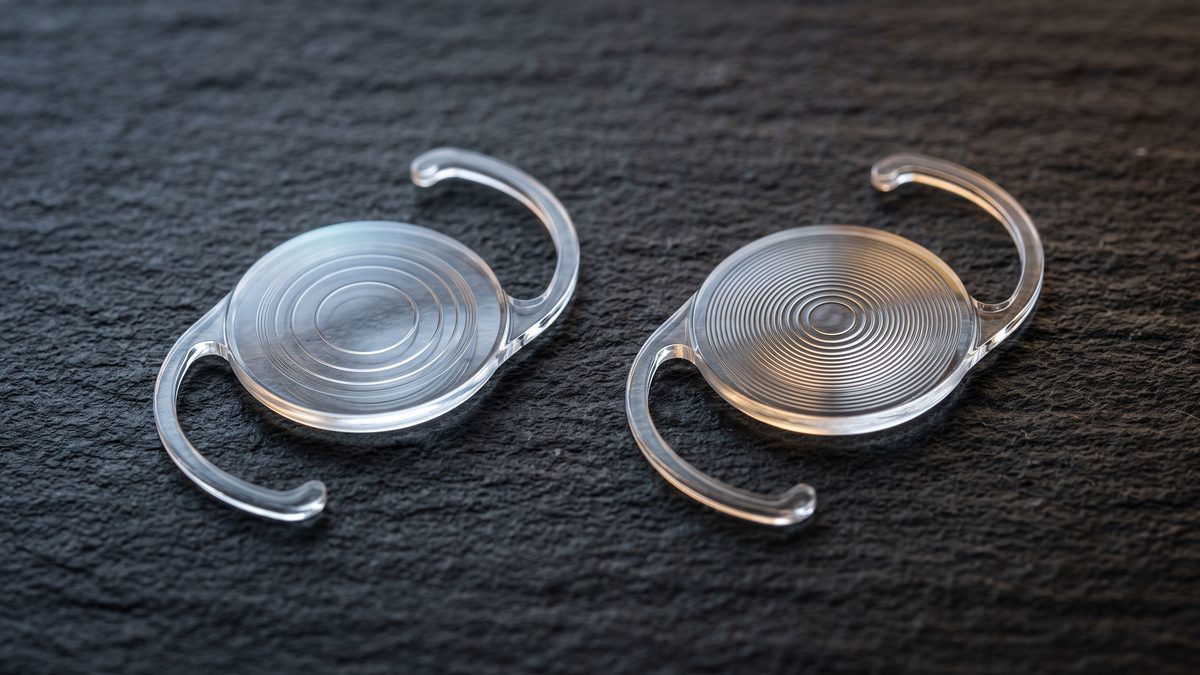
If you want the greatest range of focus in each eye, nothing beats a trifocal lens by design. Distance, arm's length, and reading are all built into the lens from day one. To get that range, both of these lenses have rings in the lens, kind of like a target etched into the lens, and those rings split the incoming light. That splitting gives you a little bit of glare and halo around lights at nighttime. Compared to the older generations of these lenses, the glare and halos are much less. But there will be some.
The PanOptix Pro is Alcon's update of the original PanOptix, a lens I have implanted for years. The rings create three focus points, and the Pro reshaped the steps of those rings so that more of the light lands on a focus point. On Alcon's bench testing, 94% of the light is used, up from 88% in the original; the rest scatters, and scattered light is what you see as glow around a headlight. That is a lab number from the manufacturer, not a patient survey. An independent lab confirmed the Pro keeps the original's layout with changes to the ring steps, and did not measure scatter, so the halving of scatter is Alcon's figure. The original PanOptix has a decade of published outcomes, and I treat that record as the Pro's record too.
The Odyssey is Johnson & Johnson's successor to the Synergy, and by the company's own description it was introduced to reduce the night symptoms patients reported with that lens. Instead of three separate focus points, the Odyssey's rings are shaped to blend them into one continuous range, from distance down to about 33 centimeters, which is phone distance. It also corrects the faint colored edge a lens can put around a bright light, which is part of why it tests so well on the distance chart. Its own patient studies run from 2025 and 2026, so it has a year or two of data where the PanOptix family has ten.
What the studies found
The only head-to-head of these two exact lenses came out in 2026: 65 eyes with the Odyssey matched against 65 eyes with the PanOptix Pro, measured one month after surgery. Uncorrected distance vision, uncorrected reading vision, vision with both eyes open and the leftover prescription were all the same. Glare, halos, light sensitivity and night-vision difficulty each stayed under 15% with both lenses, with no difference between them. The one statistical difference was two letters of best-corrected distance vision in the Odyssey's favor, which the authors say may not matter clinically.
A group at Bascom Palmer put a PanOptix in one eye and an Odyssey in the other in 19 patients, so each person was their own comparison. The Odyssey eye read one to three letters better at distance, and had slightly better contrast sensitivity, the ability to pick out a gray letter on a gray background. The PanOptix eye read about two letters better at 60 centimeters, the computer distance. Reading was the same. Halos, glare and starbursts were the same. Seventeen of the 19 patients were out of glasses entirely with both lenses. A third study, from Japan, found the same lean: Odyssey a little better far away, PanOptix a little better up close.
A randomized trial of the Odyssey against the original Clareon PanOptix, with the same lens in both eyes, is under way. The interim data presented at ASCRS 2026, 27 Odyssey patients and 17 PanOptix patients so far, showed equal uncorrected distance vision, the PanOptix about one line better at 40 centimeters, similar halo and glare rates, and more PanOptix patients saying they never or rarely saw starbursts. The study is not finished.
Halos: what patients say and what the lab says
Every direct comparison found the same rate of halos and glare with both lenses. Across 580 PanOptix patients pooled from 11 studies, about 44% noticed halos and about 1 in 100 called them very bothersome. In a 40-patient Odyssey series, 32% said they always saw halos and none were extremely bothered. Those two studies used different questionnaires, so I hold them loosely, the same way I hold every lens's own numbers. Common, and rarely a lasting problem, is the pattern with both.
In the lab, a German group measured how much light each lens scatters and found the original PanOptix scattered two to eight times less than the Odyssey, depending on the angle. Alcon says the Pro cuts its scatter in half again. On paper that should favor the PanOptix. Patients so far have not reported the difference, and I'm not going to tell you one lens has fewer halos when the patient studies say they don't. If halos don't fade for you, there are real options, which I covered in enVista Envy vs PanOptix Pro, and they apply to both of these lenses.
The case for switching, and what I say to it
One surgeon in a CRSToday roundtable (May 2025) said his enhancement rate, the share of his patients who needed a laser touch-up, was around 8% with the PanOptix and dropped to 2% when he switched to the Odyssey. The same surgeon called the differences between the PanOptix, the Odyssey, and the Envy “splitting hairs.”
I would say my touch-up rate with the Pro is less than 2%. That is my own number from my own patients. Two surgeons' own numbers, counted differently, are not a comparison of the lenses. I would say, in my experience, both of the lenses are pretty equivalent in terms of how happy the patients are afterwards.
The patient who asked for the Odyssey
I had a patient who wanted an Odyssey. They wanted really good near vision, and they were just interested in trying out the newest lens. I put the lens in the patient. They were very happy with it. At the follow-up they were reading without glasses, seeing distance without glasses, and they weren't reporting any significant nighttime glare issues.
The only reason I would put an Odyssey in is if the patient is actively requesting it, because I have had patients who are good with the Odyssey and the PanOptix Pro. Just because I have more experience with the PanOptix Pro, I'm more comfortable putting that one in. It doesn't mean the Odyssey is a worse lens. It just means that I'm more comfortable putting in the PanOptix Pro. I am comfortable putting the Odyssey in; it is just not my default.
Who should think twice about either lens
Both of these are ring-based lenses, and the same eyes should be careful with both. In my practice, I don't recommend a trifocal for patients with macular degeneration, significant glaucoma, or a corneal surface that will not settle, because the rings need a healthy eye behind them to work, and that list is not complete. If you've had LASIK, PRK or RK, the lens power is harder to predict, and I usually point those patients toward the Light Adjustable Lens instead. Or if a patient says that their nighttime vision is very important and they say that they're okay wearing reading glasses for small print up close, then I would say go to an EDOF lens, an extended depth of focus lens like the PureSee or the Vivity, because it's a more forgiving lens. For eyes that aren't trifocal candidates, a monofocal, a toric, or the Light Adjustable Lens serves you better. I wrote separately about who should not get a multifocal lens, and it applies to both of these.
If it were my own parent in the chair wanting to read, drive and work at the computer with as little help from glasses as possible, I would put in the PanOptix Pro, and I would tell her what I've told you here: the studies found no difference big enough to matter, and my own patients' results are why I reach for it. If she had her heart set on the Odyssey, I would not talk her out of it. If you're weighing the two, I'm happy to go over your measurements with you at OC Eye Associates in Irvine.
Common questions
Which is better, the Odyssey or the PanOptix Pro?
The published studies found no difference big enough to matter. The Odyssey reads one to three letters better at distance; the PanOptix reads about two letters better at arm's length. Night symptoms and reading vision are the same. In my practice I reach for the PanOptix Pro based on my own patients' outcomes.
Does the PanOptix Pro have fewer halos than the Odyssey?
Not in the patient studies. In the lab, the PanOptix scatters less light than the Odyssey, and Alcon reports the Pro scatters less again, but every study that asked patients found the same rate of halos and glare with both lenses.
Will I need reading glasses with either lens?
Many patients don't. In the same-patient study, 17 of 19 were out of glasses with both lenses. Some people still want readers for small print in dim light, and no one can promise you won't be one of them.
Is the PanOptix Pro just the old PanOptix?
Close to it. An independent lab found the same layout with changes to the ring steps that direct more light to the focus points. The original PanOptix has a decade of published outcomes, and that record carries over.
Can I get either lens if I have astigmatism?
Yes. Both come in a toric version that corrects astigmatism within the range the lens offers. A small leftover prescription can still happen, and a laser touch-up is one way to fix it.
Who should not get either of these lenses?
In my practice, patients with macular degeneration, significant glaucoma, or a corneal surface that will not settle, among others. Both lenses rely on rings that need a healthy eye behind them.
Does the PanOptix Pro cost more than the Odyssey?
In my practice, the price is the same for each lens. I'm not sure if it's different in other practices. Exact numbers are something we go through at your consultation.
Sources: Alomar et al., Cureus 2026, matched cohort of TECNIS Odyssey vs Clareon PanOptix Pro, 65 eyes each · Kang et al., Clin Ophthalmol 2026, paired-eye comparison of Clareon PanOptix and TECNIS Odyssey · Hayashi et al., J Refract Surg 2026, Odyssey vs Synergy vs PanOptix · Kremser et al., Klin Monbl Augenheilkd 2026, straylight bench comparison · Jeong et al., J Cataract Refract Surg 2026, optical metrology of PanOptix vs PanOptix Pro · Zhu et al., Ophthalmol Ther 2025, meta-analysis of PanOptix visual disturbances · Hacopian et al., Clin Ophthalmol 2026, Odyssey patient-reported outcomes · Bissen-Miyajima et al., Ophthalmol Ther 2025, early Odyssey results · Alcon, Clareon PanOptix Pro launch release, April 2025 · CRSToday, May 2025, roundtable on presbyopia-correcting IOL design (enhancement rates) · Zhu et al., ASCRS 2026 (SPS-207), randomized bilateral Clareon PanOptix vs TECNIS Odyssey, interim data
Related reading: LAL vs PanOptix Pro · enVista Envy vs PanOptix Pro · comparing premium cataract lenses · who should not get a multifocal lens · or see how a trifocal looks at night in the simulator.
Weighing these two lenses for your own eyes?
That is what a consultation is for. Bring your questions and we'll go through your measurements together at OC Eye Associates, Irvine.
Call (949) 653-9500Read next
This article is for educational purposes and is not a substitute for a medical examination or personalized medical advice. Lens choice depends on your eye measurements, your eye health, and how you spend your day; discuss it with your own surgeon.