PureSee vs Vivity: A Cataract Surgeon Compares Both Lenses
Published August 4, 2026 · Updated September 2, 2026 · Medically reviewed by Todd Driver, MD
Quick answer: Vivity and PureSee are more alike than different. In three 2026 head-to-head studies, distance was a tie and Vivity was a little better at arm's length. PureSee measured better on contrast in two of the three, and in the six-month study PureSee patients reported far fewer halos while Vivity patients read small print a little better. In my own patients, lately, I lean PureSee for the nighttime quality. The bigger decision is still EDOF versus trifocal, and that one matters more than the brand.
If you are choosing between the Vivity lens and the new PureSee lens for your cataract surgery, here is the short version. In my hands, these lenses are more alike than different, and the details below are where they part ways.
Both are extended depth of focus lenses, which means the real decision usually happens one step earlier: EDOF or trifocal. I will cover that first, because it matters more than the brand.
Trifocal vs EDOF: the decision that comes first
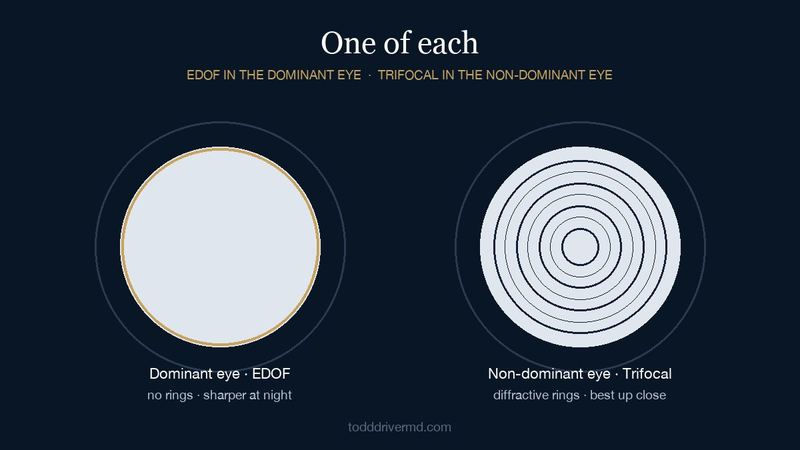
When I discuss cataract surgery with my patients, a lot of the time they are deciding between two lens families. A trifocal lens gives you very good near vision, close to your face, small print, and distance is very good too. The trade-off is faint halos around lights at night. An extended depth of focus lens flips that. Nighttime is better and glare and halos are much less of an issue, but close is not quite as good. You hold things a little further from your face.
The published numbers back that up. In a four-way comparison of lens types, about 74 percent of EDOF patients and 92 percent of trifocal patients did not need glasses after surgery, while roughly 14 percent of EDOF patients and 38 percent of trifocal patients reported glare and halos at night. So the trifocal buys you reading vision and costs you a little night quality. The EDOF buys night quality and costs you a little reading. Neither is a bad outcome. They are different trade-offs.
Both lenses in this comparison are EDOF lenses. If reading small print without glasses is your top priority, a trifocal conversation may serve you better, and I cover that in my premium lens comparison.
How the Vivity lens works
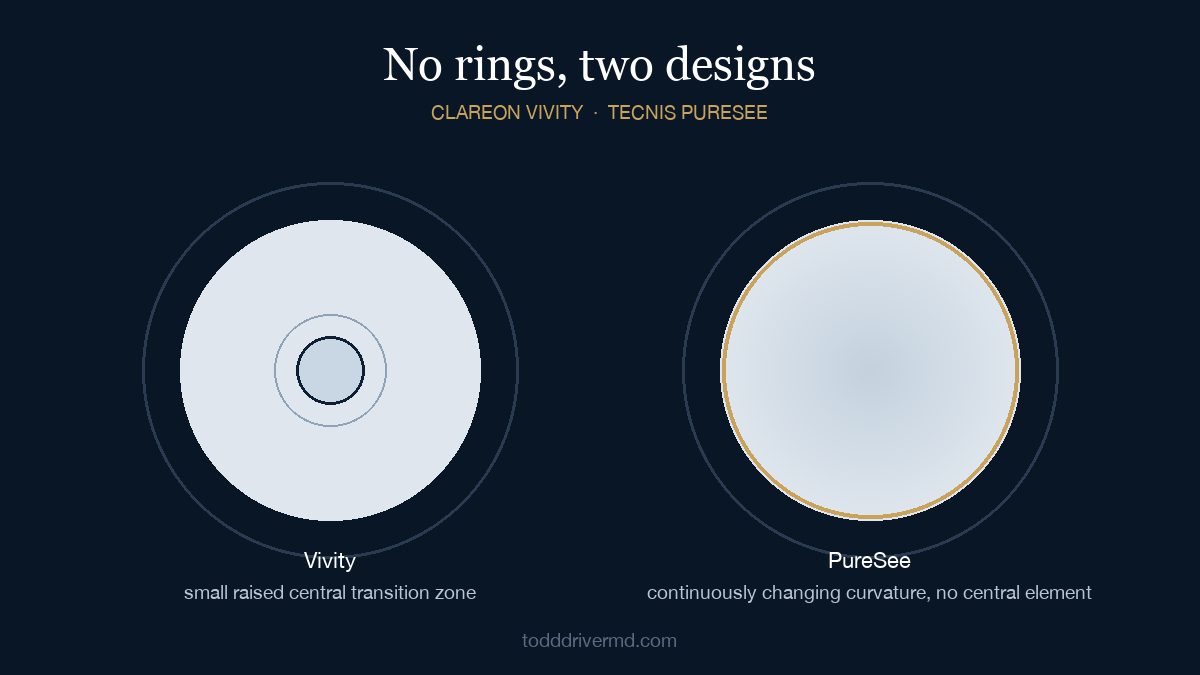
Vivity is made by Alcon. It has been implanted since 2020 and it is the most implanted extended depth of focus lens in the world. There are no diffractive rings. Instead, a small raised element in the center of the lens, a transition zone, takes one point of focus and stretches it into a longer one. Nothing splits the light into competing images.
The night vision data reflects that design. In the trial that supported its approval, halos were reported by under one percent of patients and glare by under four percent, both essentially the same as a standard single focus lens. Alcon then followed more than 900 patients across eight countries in a real-world registry, and over 91 percent reported no halos, no glare, and no starbursts at all.
The contrast warning on Alcon's own label
There is one catch, and Alcon prints it on their own label: most patients with this lens are likely to experience a loss of contrast sensitivity compared to a single focus lens. In practice, that does not mean blurry vision. It means telling charcoal gray from black on a rainy night is a little harder. Most people never notice. Some do.
This is why thorough pre-operative screening matters. If you have a condition like macular degeneration that already reduces your contrast sensitivity, it is generally best to avoid this lens. In my practice, I don't recommend EDOF or trifocal lenses for patients who have macular degeneration, because your macular health and contrast sensitivity need to be as good as possible for these lenses to work properly for you.
How the PureSee lens works
PureSee is Johnson & Johnson's new EDOF lens. The FDA approved it in March 2026, with a full United States rollout in June. It has no rings and no central element either. The back surface of the lens changes curvature continuously across the whole optic, and the front surface is designed to cancel the natural aberration in your cornea. It is a purely refractive lens, about as optically clean as a premium lens gets.
That design earns it a real distinction: PureSee is the first and only extended depth of focus lens approved in the United States without a contrast sensitivity warning on its label. It is worth understanding what that means, because it gets oversold. The regulatory bar is a specific measured difference from a single focus lens. PureSee came in under the bar. Vivity did not. It is a real result, and it is not proof that one lens beats the other in your eye.
Vivity vs PureSee: what the head-to-head studies found
Three studies published in 2026 have compared these lenses directly. Two are short: a 102-eye comparison at two months and a 106-eye comparison at three months. The third followed 85 patients with the lens in both eyes for six months and scored them on a questionnaire.
Here is what they found, and what it means for your eye. Distance vision was the same in all three. At arm's length, a dashboard or a computer screen, Vivity was a little better in all three. Up close, the two short studies found a tie; at six months, the Vivity patients read small print a little better and said so on the questionnaire. Contrast went the other way. PureSee measured better on fine detail contrast in two of the three studies, and the third found no difference. On halos and glare, the six-month questionnaire favored PureSee by a wide margin, about 1 versus 6 on a 100-point bother scale, while one of the short studies saw a small trend the other way that did not reach significance.
The contrast and halo findings match what I would have guessed from the design. PureSee has no central element in the light path, so there is less structure and less to scatter. When I look at the lens going into the eye, I don't see the button in the middle, and I feel like that offers better visual quality, especially at nighttime.
In real life, in my own patients, my PureSee patients are extremely happy after surgery. Their distance and near vision are excellent, and their nighttime vision is excellent. The six-month study is where Vivity read small print a little better; in my own patients, I haven't seen a big difference in up-close vision between the two lenses. I'm starting to favor the PureSee a little bit more.
All three studies are small. The two short ones were retrospective, and the six-month study used the older AcrySof version of Vivity rather than the current Clareon lens, so I hold these findings loosely. I have not seen a randomized trial comparing them yet.
What I see at the one-week visit
Here is something I have learned watching these patients at their first post-op visit, and I have never heard anyone say it out loud.
Every so often, a trifocal patient comes in unhappy with halos at night. Generally that is due to dry eye. The ocular surface is still recovering from surgery, and a dry, irregular surface makes halos dramatically worse than they will ultimately be. After the dry eye gets under control, the halos improve, patients adapt, and they love their near vision.
The extended depth of focus patients are the mirror image. I have essentially never had one complain about halos at night. What I do hear is that they wish their near vision were a little better. That is the honest split. They are simply the different shortcomings of each lens.
| Clareon Vivity | TECNIS PureSee | |
|---|---|---|
| Maker | Alcon | Johnson & Johnson |
| In use since | 2020 | FDA approved March 2026, US rollout June 2026 |
| Optical design | Central raised transition zone, non-diffractive | Continuously changing posterior curvature, purely refractive |
| Distance vision | Tie in all three 2026 head-to-head studies | Tie |
| Arm's length | Slightly better in all three studies | Slightly behind |
| Near vision | Tie in the two short studies; slightly better at six months | Tie in the two short studies; slightly behind at six months |
| Fine detail contrast | Slightly behind in two of three studies; no difference in the third | Slightly better in two of three studies |
| Contrast sensitivity warning on the label | Yes | No, the first US EDOF approved without one |
| Halos and glare | Under 1% halos and under 4% glare in the pivotal trial; over 91% reported none in the registry of more than 900 patients; more dysphotopsia than PureSee in the six-month head-to-head (6 vs 1 on a 100-point scale) | Over 90% report zero bothersome halos, glare, or starbursts; less than Vivity in the six-month head-to-head |
| Think twice if | You already have reduced contrast sensitivity, for example from macular degeneration | The same principle applies; in my practice, macular degeneration rules out this lens too |
Scroll the table sideways to see every column.
Which lens should you choose?
If your day revolves around a countertop, a dashboard, and a computer screen, either of these lenses will serve you well. If you want to read small print without reaching for glasses, you should be having a trifocal conversation instead, or consider a trifocal in one eye and an EDOF in the other.
With either lens, what I tell patients is that you'll hold things a little further from your face, and for really small print, a pill bottle for example, you'll need reading glasses. The only thing I hear from my PureSee patients is that they do need readers for up-close small print. They went in knowing that limitation, and they're happy with the outcome.
If a patient tells me they want the best near vision an EDOF can give, I still reach for the Vivity. If you have early macular degeneration, I would not recommend Vivity or PureSee; I would do a monofocal, a toric, or the Light Adjustable Lens. Otherwise, at this point, I would probably recommend the PureSee.
Whichever way you lean, what predicts your happiness a year from now is not the brand of the lens. It is whether your surgeon measured your cornea carefully, examined your retina and ocular surface, asked how you spend your day, and told you the truth about the trade-offs.
Common questions
Is PureSee better than Vivity?
Not by much, and not on every measure. Distance is a tie, Vivity is a little better at arm's length, and PureSee measures better on contrast and, in the longest study, on halos at night. If you want the best near vision an EDOF can give, I still reach for the Vivity; otherwise, lately, I lean PureSee for the nighttime quality. Either lens is a good choice, and which one fits you depends on your eye and your day.
Does the PureSee lens cause halos at night?
Far less than a trifocal, and in the six-month head-to-head, less than Vivity. With no rings and no central button, there is very little in the light path to scatter, and over 90% of patients report no bothersome halos, glare, or starbursts. One of the short studies saw a small trend the other way that did not reach significance.
How much does the PureSee lens cost?
It is a premium lens, so it is an out-of-pocket upgrade over the standard lens that insurance covers. In my office it is the same price as the Vivity, and the exact number comes at the consultation.
Can I get PureSee in one eye and a trifocal in the other?
Yes. That combination is common, and I wrote about it separately. The trifocal eye handles small print and the ringless EDOF eye handles night driving.
Is the PureSee lens available in the United States?
Yes. The FDA approved it in March 2026 and it rolled out nationally in June 2026.
Two interactive tools can help you compare your options: see how each lens type handles daytime detail and night driving in the interactive lens simulator, or take the 60-second lens quiz to see which option fits how you live.
Sources: Kang, Lee et al., TECNIS PureSee versus Clareon Vivity, 102 eyes at two months (Clin Ophthalmol 2026) · Jeong et al., comparative visual performance and optical stability, 106 eyes at three months (Clin Ophthalmol 2026) · Koh et al., patient-reported outcomes, PureSee versus Vivity, 85 bilateral patients at six months (Acta Ophthalmol 2026) · Alcon Clareon Vivity directions for use, pivotal trial, and real-world registry · TECNIS PureSee US approval announcement (March 2026)
Related reading: Light Adjustable Lens vs Vivity · PureSee vs Eyhance · a trifocal in one eye and an EDOF in the other · enVista Envy vs PanOptix Pro compared · comparing premium cataract lenses, brand by brand · the Light Adjustable Lens in Irvine · cataract surgery in Irvine · or call to arrange a cataract consultation in Irvine.
Considering cataract surgery?
Every eye is different. If you are weighing lens options, I am happy to walk you through what fits your anatomy and your life at OC Eye Associates in Irvine.
Call (949) 653-9500Read next
This article is for general education and is not medical advice. It does not create a doctor-patient relationship. Lens selection depends on your individual eye anatomy, ocular surface, retinal health, and visual goals. Please discuss your options with your own surgeon.