Comparing Premium Cataract Lenses in 2026: Trifocal vs EDOF vs Light Adjustable
Published August 1, 2026 · Updated September 22, 2026 · Medically reviewed by Todd Driver, MD
Quick answer: Trifocals give the widest glasses-free range in exchange for faint rings around lights at night. EDOF lenses flip that trade: cleaner night vision, weaker near. The Light Adjustable Lens is the only one that can be fine-tuned after surgery. The data below covers how each performs at distance, at the computer, and up close.
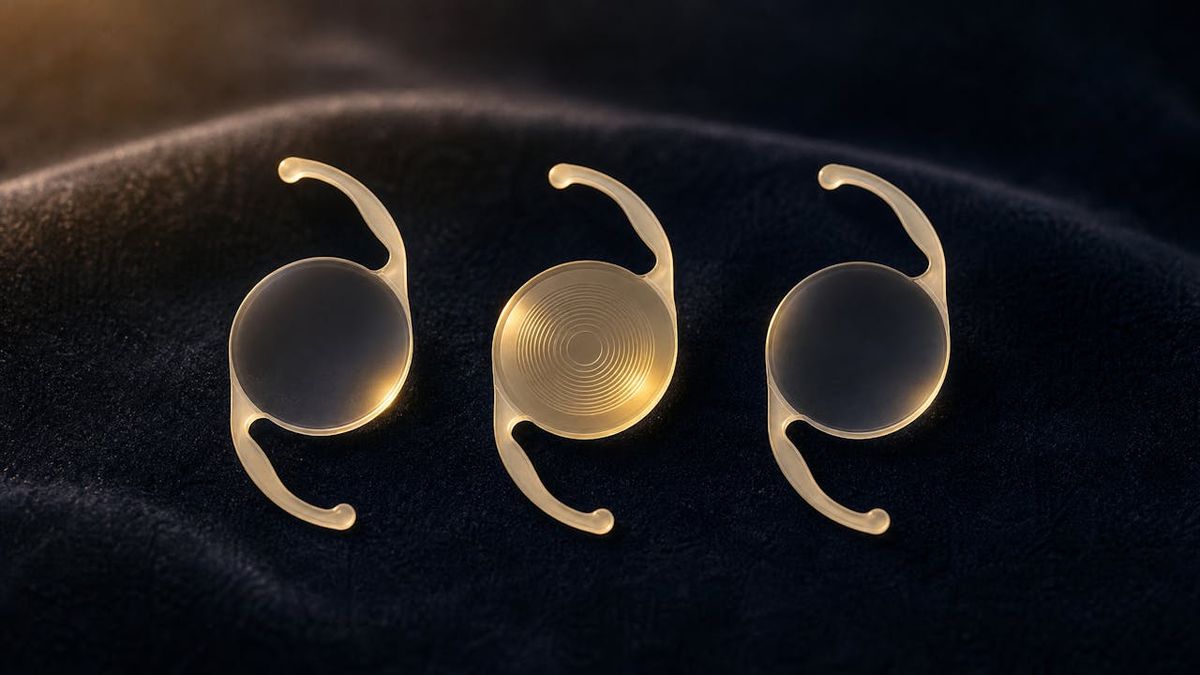
Choosing a lens implant used to be simple, because there was really only one choice. Today there are three distinct families of premium lenses, each with its own strengths, and within each family there are several excellent brands. This article is my attempt to lay out the actual data: how each lens performs at distance, at the computer, and up close, what the night glare trade-offs really look like, and how satisfied patients are afterward. At the end, I'll tell you exactly what I recommend in my own practice and why.
If you'd rather see the differences than read about them, I built an interactive lens vision simulator that shows you how each lens type sees, in daylight and while driving at night. This article is the deeper companion to that tool.
The three families of premium lenses
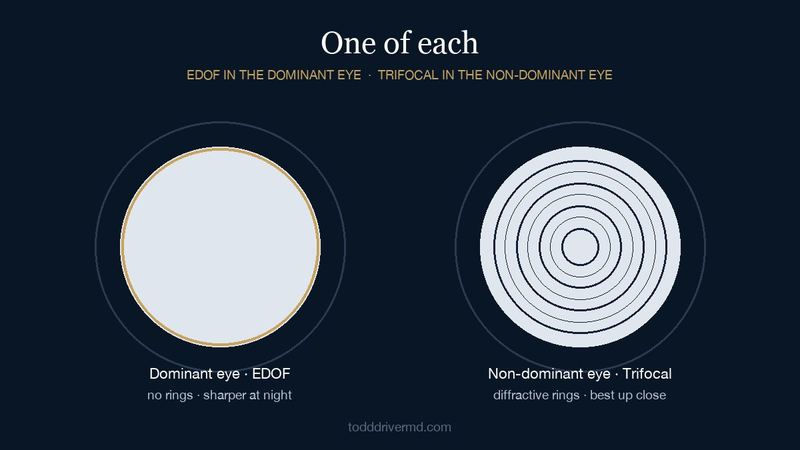
Trifocal and full range of vision lenses split or spread incoming light across distance, computer, and reading focus. You get the widest range of glasses-free vision, in exchange for some rings around lights at night. Extended depth of focus (EDOF) lenses stretch a single focal point into a continuous zone: distance and computer vision are excellent, near is functional, and night vision stays close to a basic lens. The Light Adjustable Lens takes a different approach entirely: its power is fine-tuned after surgery with light treatments, so your final prescription is based on how your eye actually healed rather than on a preoperative prediction.
The trifocal class: PanOptix Pro, TECNIS Odyssey, and enVista Envy
The newest trifocals are meaningfully better than the versions from five years ago, and the improvements are mostly about light efficiency.
Alcon's Clareon PanOptix Pro uses a redesigned optic that delivers 94% of incoming light to the retina, cutting light scatter in half compared with the original PanOptix (6% versus 12%). In clinical evaluation, only about 2.6% of patients reported being bothered by halos or glare, and in a 127-patient questionnaire study of the original PanOptix, 99.2% of patients said they would choose the same lens again.
Johnson & Johnson's TECNIS Odyssey is technically classified as a full visual range lens: a continuous profile with no gaps between the focal points, reaching from distance all the way to about 33 centimeters. It uses over 95% of incoming light, filters violet light, and corrects chromatic aberration, and bench testing shows up to twice the image contrast of classic trifocal optics in dim lighting. In multi-center studies, 93% of patients reported no or only mild halos and glare at one month, and overall satisfaction without glasses was 94%.
Bausch + Lomb's enVista Envy uses adaptive optics that shift more light toward distance as the pupil enlarges in dim conditions, which is a clever way to attenuate halos specifically at night. In its US and Canadian trials, 89.1% of patients achieved 20/32 or better uncorrected vision at all three distances, about 90% performed daily near tasks with little or no difficulty without glasses (compared with 50% for a basic lens), and overall satisfaction reached 93%.
Across the class, the numbers cluster tightly: roughly 20/20 at distance, 20/24 to 20/25 at the computer, and 20/25 or better up close, with total spectacle independence above 90%. The trade-off remains night halos. They are smaller and dimmer than with older designs, most patients rate them mild, and the brain adapts over three to six months, but a patient choosing this class should know they exist.
The EDOF class: Vivity and TECNIS PureSee
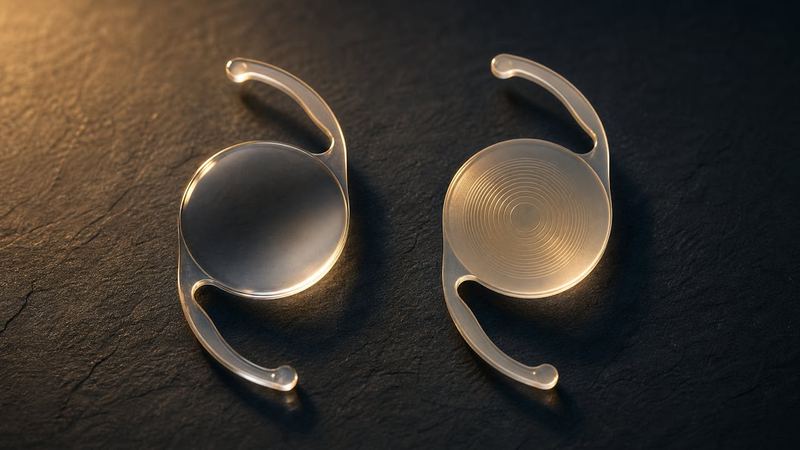
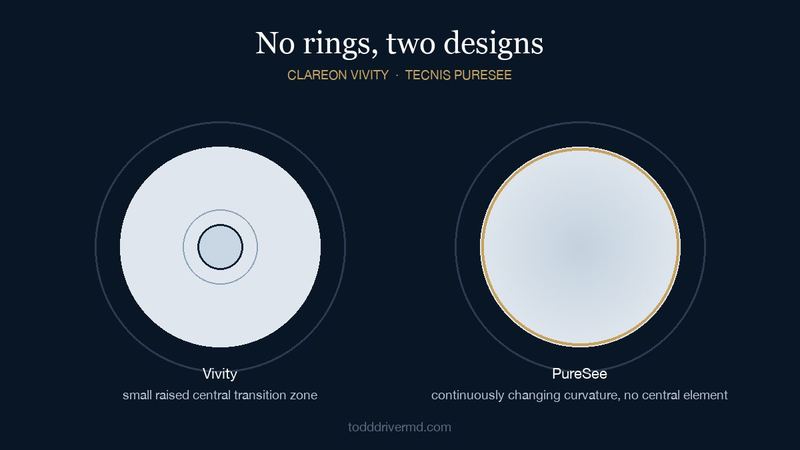
Alcon's Clareon Vivity and Johnson & Johnson's TECNIS PureSee take the opposite bet: give up some near vision to keep night vision essentially perfect. Neither lens has diffractive rings. Vivity shapes the light wavefront with two smooth surface elements; PureSee uses a purely refractive, gradually changing power profile that is fully pupil-independent.
The results are consistent across studies: 20/20 or better at distance, about 20/25 at the computer, and functional near vision in the 20/32 to 20/40 range, which means comfortable menus and phone use but reading glasses for fine print. Contrast sensitivity is equivalent to a basic monofocal, and the dysphotopsia data is remarkable: over 90% of PureSee patients report zero bothersome halos, glare, or starbursts, and Vivity's photic profile is clinically indistinguishable from a monofocal control. PureSee was the first EDOF lens approved in the US without a contrast sensitivity warning. Satisfaction runs 92% to 96%, with distance and intermediate spectacle independence around 95% and near independence around 60%.
The Light Adjustable Lens and LAL+
Every fixed lens, no matter how good, depends on a preoperative prediction of how your eye will heal. Published data show that 20% to 30% of eyes land at least half a diopter away from the vision target with standard lenses. The RxSight Light Adjustable Lens designs that problem out: starting about four weeks after your second eye, we measure your actual prescription and reshape the lens inside your eye with ultraviolet light treatments that need no incision, then lock it in. The result is precision roughly twice that of standard lenses, with 93% to 94% of eyes finishing within half a diopter of target.
The newer LAL+ adds a subtle aspheric feature in the center of the optic that extends depth of focus before any light treatment, improving computer and near range while giving up only about one letter of distance sharpness. Most patients pair it with blended vision: the dominant eye set for distance, the other given a small near boost, and because the LAL+ already has a wider focus range, the offset between eyes can stay small. You even get to test drive the balance between treatments and adjust it if you want more near vision.
The outcome data is strong. In registry data covering 2,202 eyes, 94% of distance-targeted eyes landed within half a diopter of target, 93% of patients aiming for distance in both eyes saw 20/20 or better with both eyes open, and blended vision protocols delivered 20/25 or better near vision in 82% to 88% of patients. Because the optic is a smooth silicone lens with no rings, night vision is comparable to a basic monofocal: no light splitting, no diffractive halos. Satisfaction exceeds 95% in published surveys. The commitments are real but manageable: UV-protective glasses during waking hours until lock-in, and three to five short light treatment visits.
Which premium lens do I recommend in my own practice?
For the majority of my patients, I recommend the Light Adjustable Lens Plus. The ability to customize the lens after surgery is a real benefit for almost anyone who qualifies for it: instead of predicting your result, we dial it in based on how your eye healed. And in my experience, my LAL patients simply don't complain about glare afterward. That combination of precision and clean night vision is hard to beat.
Outside of that, most of my patients choose an extended depth of focus lens. They're comfortable trading a bit of near vision for strong intermediate range and minimal glare, and for people who drive at night or are sensitive to visual disturbances, that trade makes a lot of sense.
For patients who really want killer near vision, the trifocal is the right tool. I counsel them honestly about the mild halos they may notice around lights at night. Most are fine with it, and here's the perspective I share: in my experience, the halos after surgery are generally much less than the halos those same patients were already living with from their cataracts. Trading a dense, glary cataract for a clear lens with faint rings is a trade most people are happy to make.
| Lens | Family | Maker | Distance | Intermediate | Near | Night glare reported | Satisfaction |
|---|---|---|---|---|---|---|---|
| Clareon PanOptix Pro | Trifocal | Alcon | About 20/20 | 20/24 to 20/25 | 20/25 or better | 2.6% bothered by halos or glare | 99.2% would choose it again (PanOptix family registry) |
| TECNIS Odyssey | Full visual range | Johnson & Johnson | About 20/20 | 20/24 to 20/25 | To about 33 cm | 93% no or mild halos at one month | 94% satisfied without glasses |
| enVista Envy | Trifocal, adaptive optics | Bausch + Lomb | 89.1% at 20/32 or better across all three distances | Included in the 89.1% figure | About 90% do near tasks with little difficulty | Reduced at night by the pupil-adaptive design | 93% |
| Clareon Vivity | EDOF | Alcon | 20/20 or better | About 20/25 | 20/32 to 20/40 | Photic profile clinically indistinguishable from a monofocal | 92% to 96% |
| TECNIS PureSee | EDOF | Johnson & Johnson | 20/20 or better | About 20/25 | 20/32 to 20/40 | Over 90% report zero bothersome halos | 92% to 96% |
| Light Adjustable Lens (LAL+) | Adjustable | RxSight | 94% at 20/20 or better in the 2,202-eye registry | Extended by the LAL+ aspheric center | 20/25 or better in 82% to 88% with blended vision | Matches a monofocal, no diffractive rings | Over 95% |
Scroll the table sideways to see every column.
The bottom line
There is no single best lens, only the best lens for your eyes and your life. If you want maximum precision and clean night vision, the Light Adjustable Lens Plus is my first recommendation. If you want strong everyday range with essentially no glare trade-off, the EDOF class delivers. If glasses-free reading is your top priority and mild night halos are acceptable, today's trifocals are the best they've ever been. Try the lens simulator to see the differences for yourself, then let's talk about which one fits how you use your vision. If the adjustable route appeals to you, here is the Light Adjustable Lens Plus in Irvine.
Related reading: Light Adjustable Lens vs Vivity · Odyssey vs PanOptix Pro · PureSee vs Eyhance · a trifocal in one eye and an EDOF in the other · enVista Envy vs PanOptix Pro compared · try the interactive lens vision simulator · Vivity vs PureSee compared · the Light Adjustable Lens explained · who should not get a multifocal lens · or call to arrange a cataract consultation in Irvine.
Two interactive tools can help you compare your options: take the 60-second lens quiz or see each lens in the vision simulator, day and night.
Wondering which lens fits your life?
That's exactly what a consultation is for at OC Eye Associates in Irvine.
Call (949) 653-9500Sources: Kohnen et al., vehicle headlight halo simulation of presbyopia-correcting IOLs (TVST 2023) · HDR halo assessment in IOLs (J Cataract Refract Surg 2026) · randomized paired-eye comparison of PanOptix and Odyssey (Clin Ophthalmol) · enVista Envy randomized controlled trial (PMC) · halo adaptation over 6 months after trifocal implantation (PubMed) · Schallhorn and Rajanala, Phase IV clinical registry of 2,202 bilateral LAL eyes (J Cataract Refract Surg 2026)
Read next
This article is for educational purposes and is not a substitute for a medical examination or personalized medical advice. Outcome figures cited are from published clinical trials, registries, and manufacturer data; individual results vary.