Who Should NOT Get a Multifocal or EDOF Lens
Published April 13, 2026 · Updated September 22, 2026 · Medically reviewed by Todd Driver, MD
Quick answer: Multifocal and EDOF IOLs aren't for everyone. In my practice the five reasons I steer someone away are eye disease beyond the cataract, such as macular degeneration or glaucoma that has already damaged your vision; significant dry eye we can't stabilize; prior LASIK, PRK, or RK, where the lens power is harder to hit; a strong sensitivity to halos at night; and expectations no lens can meet. A standard or toric lens gives excellent vision, and the Light Adjustable Lens is another route if glasses independence still matters to you.
You're having cataract surgery and you've heard about the premium lenses that can reduce your need for glasses. Sounds great, right? Here's the truth: those lenses are not for everyone, and if you get one when you shouldn't, you're going to be disappointed. In a recent study, about 13% of multifocal patients were dissatisfied, and about 2% ended up having the lens exchanged, most often for waxy vision or glare.
I perform a lot of premium lens implants, and I genuinely love these lenses. But a big part of my job is figuring out who will do great with them and who is likely to struggle. Being told you're not a candidate can feel like bad news. In reality, it's me protecting you from a bad outcome. Here are the five situations where I usually steer patients away from multifocal and EDOF lenses, even when they really want them.
1. Retinal disease and glaucoma
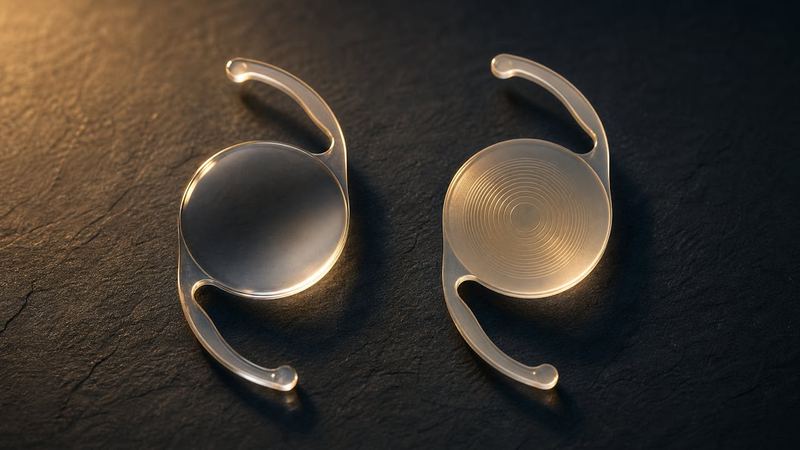
This is the biggest one. Multifocal and EDOF lenses work by splitting light into different focal points; that's how they give you distance, intermediate, and near vision at once. But that only works if the rest of your visual system can process that light well. Disease involving the central retina, like macular degeneration, or glaucoma that has already damaged your vision generally rules these lenses out: studies show patients with those conditions lose more contrast and notice more glare with multifocals. Mild, stable, early disease is a judgment call, and some patients do well with the newer non-diffractive lenses. That's a case-by-case decision after looking at your OCT and visual field. When it isn't a good idea, we usually recommend a standard lens or a Light Adjustable Lens instead.
2. Prior LASIK, PRK, or RK
Refractive surgery permanently changes the shape of your cornea, which makes the lens power calculation less predictable, so there's a higher chance of ending up a little off target and needing a touch-up. Interestingly, published results in post-LASIK eyes are encouraging: one study found 97% of post-LASIK patients satisfied or very satisfied across multifocal, EDOF and monofocal lenses. So it's not that these lenses can't work after LASIK. It's that the margin for error is smaller, the target has to be hit precisely, and that's a longer conversation. These patients are also exactly who the Light Adjustable Lens was designed for.
3. Significant dry eye
These lenses depend on a smooth, stable tear film. If your tear film is irregular or breaks up quickly, light scatters instead of focusing cleanly, and scattered light becomes glare and blur. A patient can end up unhappy with a premium lens when the real problem is the ocular surface. That's why I treat dry eye before cataract surgery for every patient, and especially for premium lens candidates. It's more common than people think: in one study, 63% of patients showing up for cataract surgery had significant tear film instability, most without any dry eye diagnosis. And it isn't just comfort: an unstable tear film throws off the measurements we use to pick your lens power, and dry eye accounted for about a third of dissatisfaction complaints after presbyopia-correcting lenses in one series. Mild or well-controlled dry eye is fine; severe dry eye we can't stabilize means rethinking the lens choice.
4. Sensitivity to halos
With any multifocal or EDOF lens, there's usually some degree of halo around lights at night. Compared to what most people see with cataracts, it's typically much better. Most patients adapt, but it takes a few months rather than weeks, sometimes up to a year, and in some patients halos persist. Optical bench testing shows the newer non-diffractive EDOF designs produce measurably smaller, dimmer halos than diffractive multifocals, which helps. But if you know halos will bother you every night drive, weigh that upfront.
5. Expectations that are hard to meet
This one isn't about your eyes at all. Every one of these lenses involves a trade: you give up a small amount of optical quality in exchange for greater independence from glasses. Most patients consider that a great deal. But if you're the type of person who needs everything absolutely perfect, and any visual compromise feels unacceptable, even a technically successful result can feel disappointing. Published work backs this up: personality studies have found patients high in perfectionism and anxiety are measurably less satisfied with multifocal lenses, which matches what I see. I'd much rather have that honest conversation before surgery than after.
What lens can I get if a multifocal or EDOF isn't right for me?
It's not the end of the world. Standard lenses work beautifully. Toric lenses correct astigmatism beautifully. And the Light Adjustable Lens, which I offer in Irvine, lets us fine-tune your vision after surgery. There is a right answer for everyone. It just may not be a multifocal or EDOF lens.
Common questions
Who should not get a multifocal IOL?
Anyone whose retina or optic nerve is already limiting vision, because a multifocal lens splits light and needs a healthy visual system to make sense of it. Dry eye we can't get under control. LASIK, PRK, or RK, because the lens power is harder to hit and the surgery already changed the cornea's optics, which a multifocal has to work on top of. Someone who already knows night halos will bother them. And someone who won't trade a little image quality for less time in glasses. Those are my five. Mild, stable disease is a case-by-case call, and prior LASIK is weighed case by case rather than ruled out.
What is the downside of multifocal lenses?
Halos and glare around lights at night are the big one. Most people adapt over months, some do not. There is also a small loss of contrast, meaning fine detail in dim light looks a little softer. In one study about 13% of multifocal patients were dissatisfied and about 2% had the lens exchanged, most often for waxy vision or glare. On optical bench testing, which is a lab measure and not a patient survey, the newer non-diffractive EDOF designs produce smaller, dimmer halos. They typically give you less near vision in exchange.
Can I get a multifocal IOL if I have glaucoma?
It depends on whether the glaucoma has affected your vision. Glaucoma that has already damaged your vision generally rules these lenses out, because you lose more contrast and notice more glare. Early, stable glaucoma with a full visual field is a judgment call after looking at your OCT and visual field, and some of those patients do well with the newer non-diffractive lenses. Either way, a standard lens is a reliable alternative. The Light Adjustable Lens is an option too, as long as your pupil dilates enough for the adjustments.
Can I get a multifocal lens if I have had LASIK?
Sometimes. The surgery is the same, but LASIK makes the lens power calculation less predictable, and a multifocal lens has to land close to target to work well. One study found 97% of post-LASIK patients satisfied or very satisfied, though it pooled multifocal, EDOF, and monofocal lenses together, so it doesn't tell you how the multifocals did on their own. In my practice these are also the patients I most often talk with about the Light Adjustable Lens, because we can adjust the power after the eye heals. A standard lens with glasses is a perfectly good answer here too.
Sources: AAO Cataract in the Adult Eye Preferred Practice Pattern (Ophthalmology 2022) · Sánchez-Sánchez et al., multifocal IOLs in glaucoma and dry AMD (J Ophthalmol 2021) · Bucci, IOL satisfaction in post-LASIK eyes (Eye Contact Lens 2023) · Trattler et al., PHACO study of ocular surface disease in cataract patients (Clin Ophthalmol 2017) · Epitropoulos et al., tear osmolarity and keratometry variability (J Cataract Refract Surg 2015) · Gibbons et al., causes of dissatisfaction after presbyopia-correcting IOLs (Clin Ophthalmol 2016) · García-Pedreño et al., HDR halo assessment in IOLs (J Cataract Refract Surg 2026) · Kohnen et al., headlight halo simulation of presbyopia-correcting IOLs (TVST 2023) · Susanna et al., dissatisfaction and photic phenomena after presbyopia-correcting IOLs (J Refract Surg 2025) · Kamiya et al., multifocal IOL explantation case series (Am J Ophthalmol 2014) · Rudalevicius et al., personality and multifocal IOL satisfaction (Eye 2020)
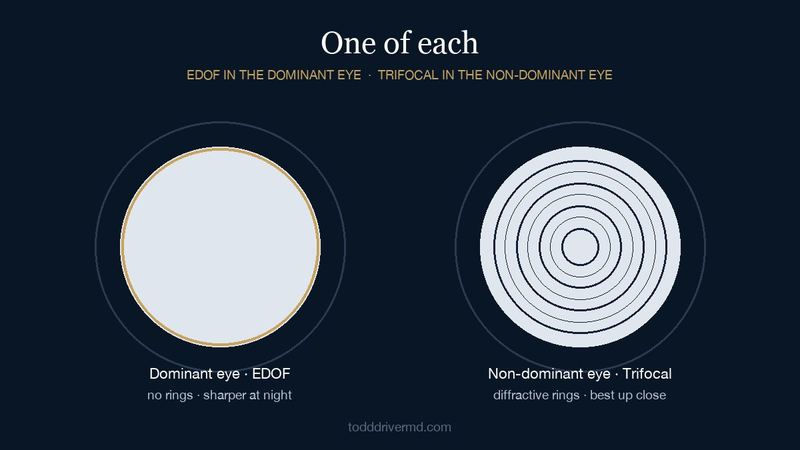
Related reading: AREDS 3 vs AREDS 2: should you switch your eye vitamins? · a trifocal in one eye and an EDOF in the other · enVista Envy vs PanOptix Pro compared · all four cataract lens options compared · the Light Adjustable Lens explained · the Light Adjustable Lens at our Irvine practice · Vivity vs PureSee compared · the five questions to ask your cataract surgeon · or call to arrange a cataract consultation in Irvine.
Two interactive tools can help you compare your options: take the 60-second lens quiz or see each lens in the vision simulator, day and night.
Not sure which category you fall into?
A consultation sorts it out: eye health, measurements, and an honest conversation. OC Eye Associates, Irvine.
Call (949) 653-9500Read next
This article is for educational purposes and is not a substitute for a medical examination or personalized medical advice.