Dr. Todd Driver · Cataract & Refractive Surgery · Orange County, CA
Precision surgery.
Clarity you can see, and understand.
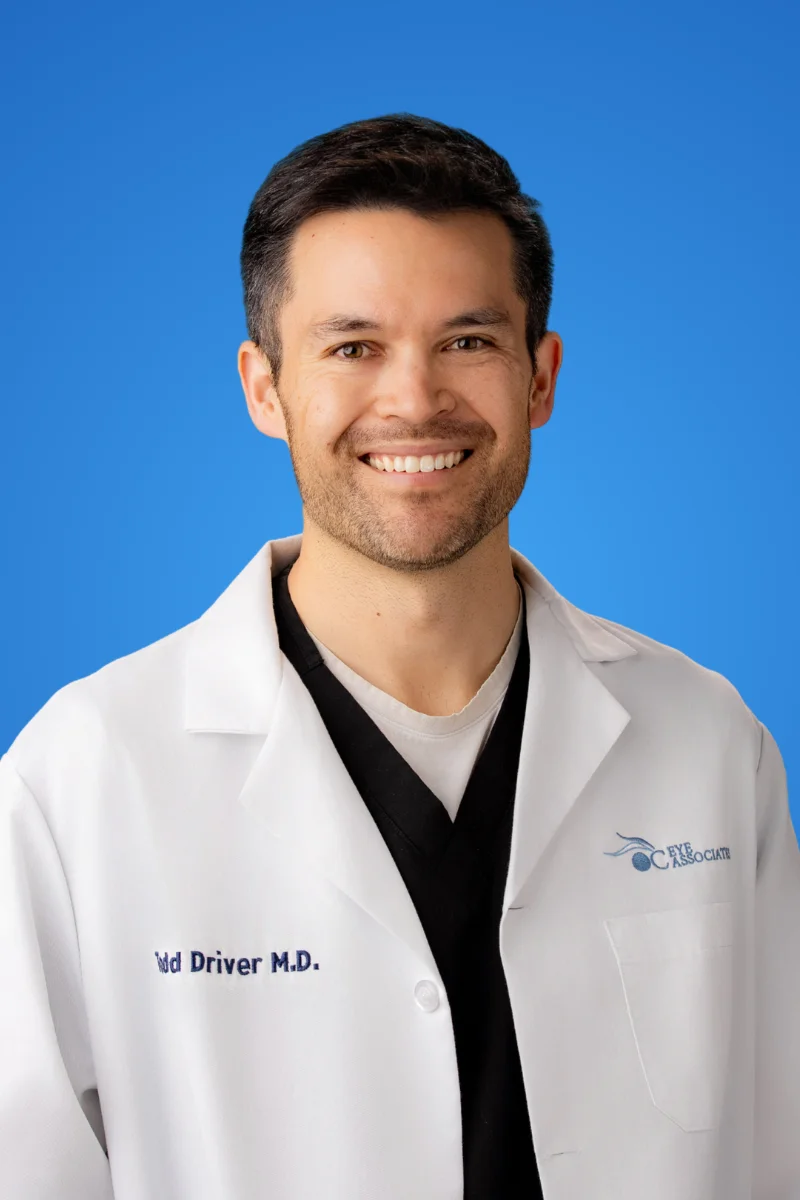
I'm Dr. Todd Driver, a fellowship-trained cataract and refractive surgeon. I restore vision with advanced surgical techniques, and I make sure you understand every step before we take it.
Or call the practice directly: (949) 653-9500
Philosophy of Care
How I help you choose the right cataract lens
Your eyes. Your decision. My training.
Modern cataract surgery is one of the most refined procedures in medicine, but no technology replaces judgment, and no outcome matters more than yours. My approach is simple: I take the time to understand how you actually use your vision, explain your options in plain language, and recommend only what I would recommend to my own family. Advanced surgery, without the sales pitch.
About Dr. Driver
About Dr. Todd Driver, board-certified cataract surgeon in Irvine
Few things in medicine change a life in ten minutes. This is one of them.
I chose cataract surgery for its immediacy. A patient arrives seeing the world through fog, and hours later it's lifted: colors sharper, faces clearer, independence restored. After thousands of procedures, that moment has never stopped being the best part of my job.
I'm a board-certified Orange County ophthalmologist and cataract surgeon at OC Eye Associates in Irvine, California. In 2026, I was selected as a 2027 Physician of Excellence by the Orange County Medical Association (OCMA), a peer-reviewed recognition featured in Orange Coast Magazine. My practice centers on advanced cataract surgery with premium intraocular lenses (IOLs), including the Light Adjustable Lens and toric lenses for astigmatism, along with laser vision correction. Curious how the lens options compare? Try my interactive lens vision simulator to see the difference for yourself, in daylight and at night. I earned my medical degree at UCSF, where I was elected to the Alpha Omega Alpha Honor Medical Society. I trained at UCLA's Jules Stein Eye Institute, earning awards for teaching residents and medical students, and completed fellowship training in cornea, external disease, and refractive surgery at UCSF's F.I. Proctor Foundation. Teaching is still central to how I practice. It's why I publish patient education videos, and why I try to make sure every consultation ends with your questions answered.
Away from the operating room, you'll find me outdoors, usually on skis. It's a habit from my Colorado years that Southern California hasn't managed to break.
Patient Stories
What cataract surgery patients in Orange County say
In their own words.
No scripts, no actors. Real patients describing their experience and their results.
Kathy · Cataract surgery patient of Dr. Driver
Jerry · Cataract surgery patient of Dr. Driver
Patient Education
Cataract surgery questions, answered by a surgeon
Clear answers, before you ever step into an exam room.
Choosing eye surgery shouldn't feel like a leap of faith. On my channel, I break down cataract surgery, lens options, and what recovery really looks like. They're the same explanations I give my patients, available to anyone.
Explore the Video LibraryIs Cataract Surgery Scary? The truth about what you'll actually see · read the article
Can I Go Blind From Cataract Surgery? An honest look at the risks · read the article
Why You Still Need Glasses After Cataract Surgery. Astigmatism and lens options · read the article
Interactive Tool
See How Each Cataract Lens Option Looks, Day and Night
Compare monofocal, toric, trifocal, extended depth of focus, and the Light Adjustable Lens in a photo-realistic simulator, including halos and glare while driving at night.
Try the Lens Simulator Take the 60-Second Lens QuizAcademic & Surgical Training
Training: UCSF, UCLA Jules Stein, and the UCSF Proctor Foundation
Trained at the institutions that set the standard.
Every recommendation I make is backed by training at some of the most rigorous programs in American ophthalmology.
Undergraduate
University of Colorado, Boulder
Foundation in the sciences
Medical Degree
UCSF School of Medicine
Elected to the Alpha Omega Alpha Honor Medical Society
Ophthalmology Residency
UCLA Jules Stein Eye Institute
Among the most selective residencies in the specialty
Fellowship
UCSF Proctor Foundation
Advanced subspecialty surgical training
Common Questions
Cataract surgery FAQs
Answers before you ask.
The questions I hear most often in consultation. For anything else, my video library goes deeper, or just ask when you visit.
Is cataract surgery painful?
No. The eye is numbed with drops, and most patients describe only mild pressure or a light show of colors. The procedure itself usually takes around ten minutes per eye, and most people are surprised by how easy the experience is.
How long is recovery?
Most patients notice clearer vision within a day or two. Light activity is fine within 24 hours, and vision continues to sharpen as the eye fully heals over several weeks. You'll use prescription drops during that time and see me for a few short follow-up visits.
Can cataract surgery correct astigmatism?
Yes. Astigmatism can be treated during the same procedure with a toric lens or precise surgical techniques. Correcting it at the time of surgery meaningfully reduces your dependence on glasses afterward.
Which lens implant is best?
There is no single best lens, only the best lens for your eyes and your life. Options range from standard monofocal lenses to extended-depth-of-focus and multifocal designs, and the Light Adjustable Lens, which can be fine-tuned after surgery. You can compare how each lens type sees in my interactive lens simulator. At your consultation we match the technology to how you use your vision.
Do I need surgery if my vision still seems okay?
Not necessarily. Cataracts progress slowly, and the right time for surgery is when they begin interfering with things you care about: driving at night, reading, recognizing faces. An evaluation tells us where you stand, and I don't ask anyone to decide before they're ready.
How do I choose a cataract surgeon?
Look for board certification, fellowship training, substantial surgical volume, and access to modern technology. My cataract surgery page covers what to expect in detail. Then pay attention to how the surgeon communicates: you should leave a consultation understanding your options, not more confused by them.
Which premium lenses do you implant?
Toric lenses for astigmatism, extended depth of focus and multifocal lenses for a wider range of vision, and the Light Adjustable Lens. Which one fits depends on your measurements and how you use your vision, not on which is newest.
Do you offer the Light Adjustable Lens?
Yes. The Light Adjustable Lens is the one lens whose prescription can be fine-tuned after your eye has healed, using light treatments in the office. It asks more of you in follow-up visits than a standard lens, so at consultation we talk through whether that trade is worth it for your eyes.
Do you use laser-assisted cataract surgery and ORA?
Yes, in the cases where the evidence supports them. Femtosecond laser assistance and intraoperative aberrometry are genuinely useful, particularly in eyes with prior LASIK or unusual measurements. They are not automatically better for every eye, and I will tell you plainly when standard technique will do just as well.
Do you perform LASIK?
Yes, along with PRK. I completed fellowship training in cornea, external disease, and refractive surgery at UCSF's Proctor Foundation. Whether you are a candidate, and which procedure suits you, depends on your prescription, your corneal thickness, and the health of your ocular surface.
Do you treat keratoconus?
Yes. I perform corneal cross-linking, which is used to slow the progression of keratoconus. Cornea was my fellowship subspecialty, so keratoconus and other corneal conditions are a regular part of my practice.
What is your training?
I earned my medical degree at UCSF, where I was elected to the Alpha Omega Alpha Honor Medical Society. I completed my ophthalmology residency at UCLA's Jules Stein Eye Institute, where I received awards for teaching residents and medical students, and fellowship training in cornea, external disease, and refractive surgery at UCSF's F.I. Proctor Foundation.
Where do you see patients?
At OC Eye Associates, 9 Corporate Park, Suite 150, Irvine, CA 92606. I am also a member of the medical staff at Hoag. Appointments are made by phone at (949) 653-9500.
Take the Next Step
Book a cataract consultation in Irvine
Better vision starts with a conversation.
Schedule a consultation at my clinical practice, OC Eye Associates. We'll evaluate your vision, walk through your options, and build a plan that's right for you. You set the timeline.
Call to Book: (949) 653-9500OC Eye Associates · 9 Corporate Park, Suite 150, Irvine, CA 92606