The Light Adjustable Lens: The Only Cataract Lens You Can Fine-Tune After Surgery
Published February 14, 2026 · Updated September 10, 2026 · Medically reviewed by Todd Driver, MD
Quick answer: The Light Adjustable Lens is the only cataract lens whose power can be changed after surgery. Once your eye heals, we fine-tune the prescription with UV light treatments, then lock it in permanently. In the FDA trial, twice as many LAL eyes reached 20/20 without glasses compared with a standard lens.
Imagine being able to adjust your vision after cataract surgery. Not before. After. Most cataract lenses lock in your prescription on the day of surgery. The Light Adjustable Lens (LAL) doesn't: it's the only lens that lets us fine-tune your vision once your eye has healed.
Why this lens exists
One of the biggest worries I hear about cataract surgery is "What if my vision isn't quite right afterwards?" It's a fair question. To pick the right lens power, we measure the length of your eye and the curvature of your cornea and plug the numbers into advanced formulas. Those calculations are very accurate, but they are still educated predictions, and a small but meaningful percentage of patients end up with more residual prescription than expected, often requiring glasses. The LAL removes most of that uncertainty: whatever prescription is left over after surgery, we can correct it within the lens's adjustment range.
How does the Light Adjustable Lens work after cataract surgery?
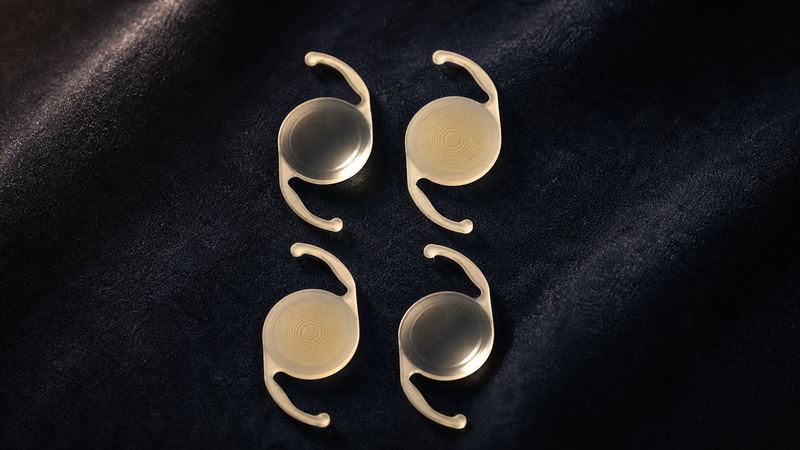
The lens goes in during ordinary cataract surgery. Then, once your eye has healed, we shine a pattern of UV light on it in the office, over a few visits, to change its power, and when the prescription is right we lock it in. The surgery itself is an ordinary cataract operation. The adjustment visits and the UV glasses afterward are what set this lens apart.
This is the cool part. The LAL is made of a special silicone material containing molecules called macromers, which react to a specific wavelength of UV light. About four weeks after your second eye, we check your prescription, dilate your pupil, and if adjustments are needed, shine a precise pattern of UV light onto the lens for about 90 seconds. That triggers a chemical reaction that physically reshapes the lens, which changes its power. A few days later we recheck, adjust again if needed, then lock the lens in permanently with final UV treatments.
Think of it this way: a traditional lens is a suit off the rack. The LAL is a suit off the rack that then gets tailored to your body.
Three generations, and why the old complaint no longer applies
The original LAL worked well but had one big inconvenience: patients had to wear special UV-blocking glasses at all waking hours, indoors and out, for four to six weeks, because stray UV light could unintentionally reshape the lens. Many found that stressful.
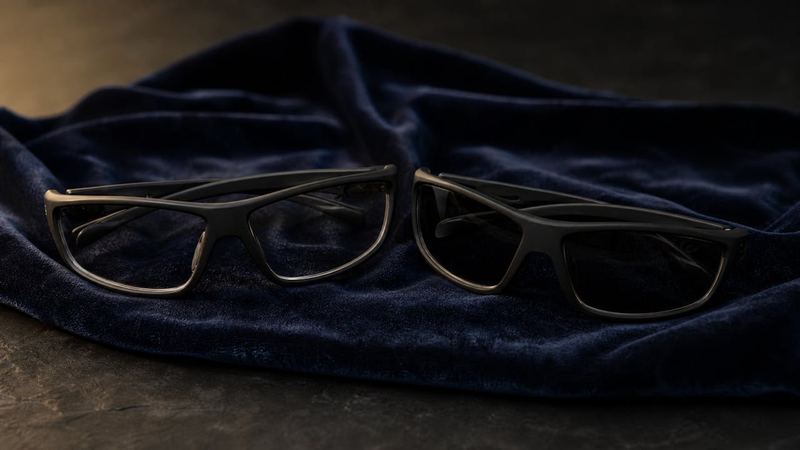
The second generation, the LAL 2.0 with ActivShield, built a UV-absorbing layer into the lens itself. The lens is less sensitive to stray UV light than the original was, but it is not immune to it. RxSight's instructions haven't changed. You wear the UV-protective glasses indoors and outdoors, during all your waking hours, until your final lock-in is done, and if you were exposed to UV light without them, or think you might have been, tell your surgical team. That layer is why I can usually reassure a patient who had a brief, unintended exposure. It doesn't replace the glasses. I go over which pair to wear, and when, at each adjustment visit.
The newest version, the LAL+, keeps the adjustability and ActivShield and adds a design change that provides extended depth of focus: better intermediate and near vision without the halos and glare commonly associated with multifocal lenses. In my experience, patients have done extremely well with this lens.
The treatment timeline
Surgery day is standard cataract surgery, nothing different, except you go home in UV-protective glasses provided by RxSight, the company that makes the lens (regular sunglasses are not sufficient). In my practice we do the first eye, then the second about two weeks later, and then wait four more weeks while your eyes heal. Your vision isn't final yet, and that's expected. Then the customization starts: we check your vision, talk about your goals, sometimes preview different options, and perform the first 90-second light treatment. Over the following weeks we reassess and adjust as needed. You get up to three adjustments and most of my patients need one or two, and then two lock-in treatments a week apart make the result permanent. Start to finish, most patients are wearing the UV glasses for about two to three months.
What the studies show
In the FDA trial that led to approval, 600 eyes were randomized between the Light Adjustable Lens and a standard monofocal. At six months, 70% of the LAL eyes were seeing 20/20 or better without glasses, compared with 36% of the monofocal eyes. That trial enrolled patients with astigmatism, and it is the clearest evidence we have that being able to adjust the lens afterward changes the result.
For the LAL+, which is the newer version, a multicenter registry of 100 patients found 89% seeing 20/20 or better at distance with both eyes open and no glasses, and 99% at 20/25 or better. Near vision at 40 centimeters was 20/25 or better in 82%. Worth knowing that most of those patients were set up with blended vision, one eye favoring distance and the other favoring near, so those are both-eyes-open numbers rather than what either eye does on its own.
The number I find most telling is a different one. In that same registry, 55% of patients changed their target prescription during the adjustment period, after they had been living with the lens and could actually see what it looked like. That is the argument for an adjustable lens in a single statistic. More than half of people wanted something other than what was planned for them, and with this lens they could still have it.
In eyes with prior LASIK or PRK, where the lens calculation is less predictable to begin with, published series of the LAL report 86% and 93% of eyes landing within half a diopter of target. Those are single-arm studies rather than head-to-head comparisons against a standard lens, so treat them as what the LAL does in these eyes rather than as proof it beats the alternative.
On safety, the light treatments themselves do not damage the retina. The longest follow-up published is a seven-year study of patients implanted between 2008 and 2012, which found refraction stable and no lens-related problems. Two caveats on that one: only 61 of the original 445 patients came back to be examined, and it was an earlier generation of the lens than what we implant today.
How long does the Light Adjustable Lens last?
The Light Adjustable Lens is a permanent implant from the day it goes in, the same as any other cataract lens. It does not wear out, and in the ordinary course it is never replaced. Lock-in does not change that; it only ends the adjusting.
The adjustability does not last. Each light treatment uses up some of the light-sensitive material in the lens, and the two lock-in treatments use up the rest. Once both lock-ins are done and I confirm it, the lens is no longer light-reactive, so ordinary sun exposure isn't expected to change your prescription, and that is when the UV glasses come off. Until I tell you that, they stay on during all your waking hours.
Your prescription can still drift a little over the years, but that comes from the eye, not the lens. The cornea changes shape slowly with age and a small amount of astigmatism can creep in. The same thing happens with every lens implant. The other thing that can blur vision years later is the thin capsule behind the lens, which hazes over in somewhere between 20 and 50% of patients depending on the study, with every type of implant. That is cleared with a quick laser polish in the office, and it works the same way with the LAL, with one difference: we wait until after your final lock-in to do it.
The seven-year study above is the longest look anyone has published at how these lenses hold up, and it was about the lens holding still, not about the eye around it.
Who's a great candidate, and who isn't
You may be a great candidate if you've had LASIK or PRK (where standard calculations are less predictable), if you have astigmatism and want to avoid relying on precise lens alignment during surgery, if you care deeply about visual precision and are willing to invest time fine-tuning, or if you want a wide range of vision without the halos and glare of multifocals; the LAL+ is especially helpful there.
It may not be ideal if you take medications that increase UV sensitivity, have a history of ocular herpes, have pupils that don't dilate well enough for the treatments, have significant dry eye causing fluctuating vision, can't commit to multiple follow-up visits, or simply want the fastest, simplest recovery possible. The key: this lens rewards patience and participation.
My honest take
The Light Adjustable Lens is the only lens that can be fine-tuned after surgery, and it is the only lens whose power I can change after your eye has healed, and the results stay stable for years. If I were having cataract surgery, I would choose the LAL for myself. The trade-offs are more follow-up visits, two to three months of UV-protective glasses, and a higher out-of-pocket cost. If you value accuracy, customization, and control over the final result, it's the lens I reach for. If you want the fastest, simplest path and are comfortable with very good vision, a standard or conventional premium lens may be the better choice. As always, the right decision depends on your eyes, your goals, and your lifestyle.
Related reading: the Light Adjustable Lens at our Irvine practice: candidacy & process · all four cataract lens options compared · toric lenses for astigmatism correction · the UV glasses, explained · how many adjustments you get · what lock-in is · LAL and near vision · the LAL after LASIK · the LAL after RK · or call to arrange a cataract consultation in Irvine
Sources: Doane et al., clinical data registry comparing two light adjustable lenses (J Cataract Refract Surg 2025) · FDA premarket approval P160055, summary of safety and effectiveness · Jones et al., LAL outcomes in eyes with prior corneal refractive surgery (J Cataract Refract Surg 2024) · Schallhorn and Rajanala, Phase IV clinical registry of bilateral LAL patients (J Cataract Refract Surg 2026) · Schojai et al., 7-year results of the light adjustable lens (J Cataract Refract Surg 2020)
Two interactive tools can help you compare your options: take the 60-second lens quiz or see each lens in the vision simulator, day and night.
Curious whether you're an LAL candidate?
It takes one consultation to find out. OC Eye Associates, Irvine.
Call (949) 653-9500Read next
This article is for educational purposes and is not a substitute for a medical examination or personalized medical advice.