Can You Put a Different Lens in Each Eye? A Trifocal and an EDOF Together
Published September 2, 2026 · Updated September 22, 2026 · Medically reviewed by Todd Driver, MD
Quick answer: Yes. A trifocal in one eye and an extended depth of focus (EDOF) lens in the other is a common plan, and some of my happiest patients have exactly that. The trifocal eye gives you by far the best reading vision, including small print. The EDOF eye has no diffractive rings, so it gives you sharper vision at night with less glare and halo. When your two eyes work together, the strengths of each lens cancel out the weakness of the other. I usually put the EDOF in the dominant eye. In a 90-patient study that compared all three approaches, patients with PanOptix in one eye and Vivity in the other scored higher on a standard vision questionnaire than patients with either lens in both eyes.
The second eye does not have to match the first. I say that to a lot of patients who had a trifocal put in a year or two ago, love reading without glasses, and wish the headlights at night looked the way they used to. A trifocal in one eye and an extended depth of focus lens in the other is one of the more common premium-lens plans in my practice, and it is the one I get the most questions about.
What the trifocal costs you at night
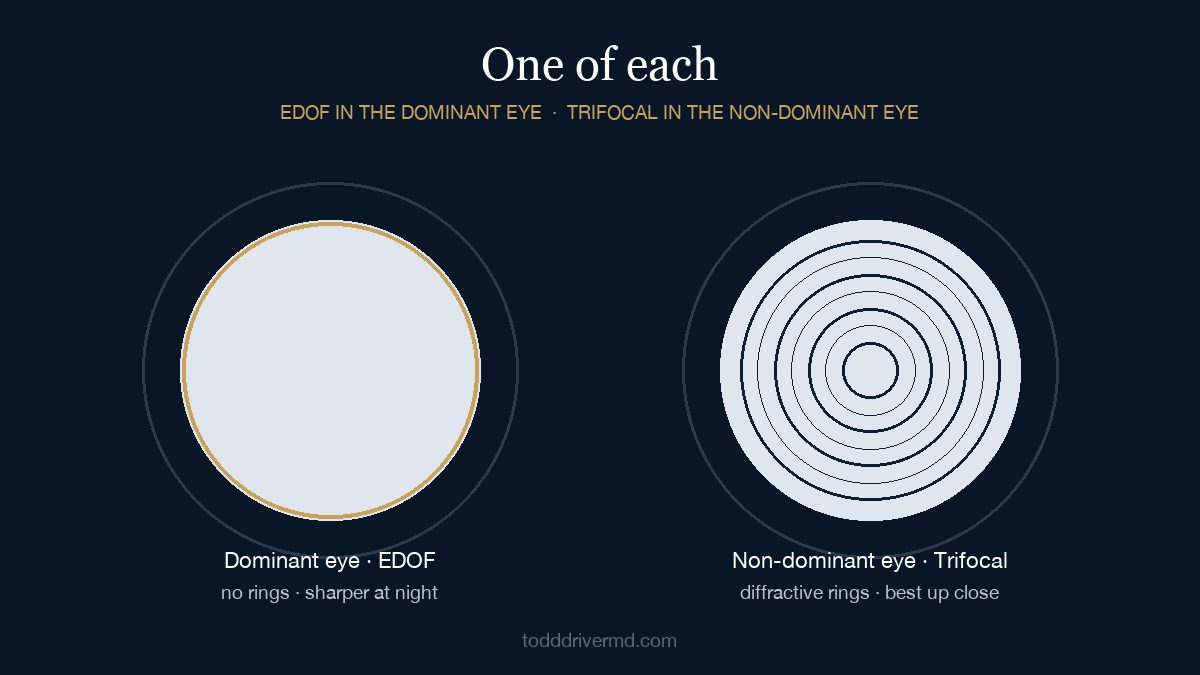
So, what I tell patients is that a trifocal lens gives you by far the best vision that is near to your face, and for small print. The main trade-off is that, to accomplish this, the lens has diffractive rings on it, and those rings give you a little bit of glare and halo at nighttime. Vision in normal lighting is excellent. Vision degrades when the lighting is low.
The rings work by splitting the light entering your eye into multiple focus points. That is how one lens can give you good near, intermediate, and distance vision at the same time. It is also why a streetlight or a headlight at night has a ring around it. Every diffractive lens does some of this, the newest trifocals less than the older ones. Most people get used to it. In my experience, the patients who hate the halos in the first few weeks usually have dry eye during recovery, and once the surface of the eye settles down, most of them adapt and end up loving the near vision.
The EDOF in the other eye is how you get your nights back
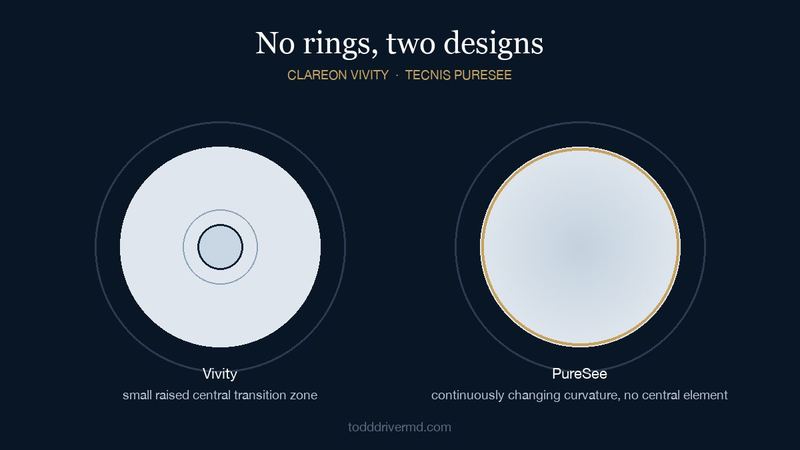
If you're finding that your vision is a little suboptimal after a trifocal, you can get the extended depth of focus lens in the other eye, and a lot of patients do. The EDOF lens doesn't have any rings in it. The two I use are the Vivity and the PureSee, and neither one has rings. The EDOF gives you sharper vision at night because there is not as much glare and halo.
The only trade-off is that, because there are no rings, the near vision is not as good as the trifocal. You can still see larger print pretty well, held maybe a little further from your face, but the trifocal is definitely better up close.
Put one of each in and you get most of both. In a 90-patient study of PanOptix and Vivity, the group with one of each scored highest on the National Eye Institute's vision questionnaire, with significantly better ratings for both near activities and distance activities. A separate 50-patient series of the same combination found 84% of patients needed no glasses at all, 94% would choose the same lenses again, and only 0 to 4% were "bothered very much" by halos, glare, or starbursts.
Not every study finds a satisfaction gap. A 2022 trial that used an older EDOF with a bifocal lens found the mixed group and the trifocal group equally satisfied, with fewer halos in the mixed group. How much of a win that is depends on how much the halos bother you.
Which of my eyes gets the EDOF and which gets the trifocal?
Generally, I put the EDOF in the dominant eye. Your dominant eye does more of the work for distance, and distance is where the EDOF is strongest and where halos matter most, since night driving is a distance task. The trifocal in the non-dominant eye covers the near work, and the two work well together.
If it has to be the other way around, trifocal in the dominant eye and EDOF in the non-dominant, I still think it's a good combination. When your eyes are working together they can still iron out the imperfections in either one. Sometimes the first eye was already done with a trifocal and it happened to be the dominant one.
Do big pupils make my halos worse with a trifocal?
With a bigger pupil, more of the diffractive rings are exposed to light at night, so you can have worse glare and halo from a trifocal than someone with a small pupil would.
A small pupil also acts like a pinhole and stretches the range of focus of any lens, the same reason squinting sharpens things a little. A bigger pupil has less of that pinhole effect, so the range of focus with any lens, whether it's a trifocal or an EDOF, is not as great as it would be for someone with a smaller pupil.
If anything, a large pupil is a reason to want the ringless lens in the dominant eye.
The first eye is the test
If you really, really want good near vision, in my practice the trifocal goes in the non-dominant eye first. If you're happy with that vision and not really bothered by glare, I put a trifocal in the dominant eye too, and the two eyes work together with really good vision at every distance. If the trifocal in the non-dominant eye bothers you with glare and halos, the extended depth of focus lens goes in the dominant eye.
If you're leaning toward an EDOF, we do the reverse. The EDOF goes in the dominant eye first so you can see how you like it. If you want better near vision than it gives you, the trifocal goes in the non-dominant eye. If you're happy with your near vision, the second eye gets an EDOF as well.
What I still tell everyone first
I still feel the best option for most patients is the Light Adjustable Lens Plus in both eyes, because we can dial in your near and distance vision after surgery instead of guessing before it. It costs more, it takes extra visits for the adjustments, and not everyone is a candidate.
If you don't want to pay the extra money, or spend the extra time on adjustments, or you're not a candidate, and you really want good near vision but want to minimize glare and halos at night, then the mix-and-match is the plan I'd have you do.
So, here's the bottom line. If you already have a trifocal and the nights are harder than you expected, an EDOF in the other eye is a reasonable next move, and one I've seen make a lot of patients happy. If you haven't had either eye done yet, the first eye can be the test, and the question to bring to your consultation is which lens goes first and why.
Common questions
Can you have a different lens implant in each eye?
Yes. Your two eyes do not need matching implants. A trifocal in one eye and an extended depth of focus lens in the other has been studied head to head against matching lenses in both eyes, and it holds up.
Which eye should get the trifocal?
Usually the non-dominant eye. The dominant eye does more of the distance work, and that is where the ringless EDOF lens has its advantage, especially at night. If the dominant eye already has a trifocal, the reverse arrangement still works well.
Will the EDOF eye get rid of the halos from my trifocal eye?
Not entirely. The trifocal eye still has its rings. With both eyes working together, the eyes can iron out some of the imperfections in either one, and in one 2026 series patients with the mix reported no halo at all more often than patients with a trifocal in both eyes (56% versus 41%).
Is mixing lenses better than a Light Adjustable Lens in both eyes?
In my opinion, no. The LAL Plus lets us adjust your vision after surgery, which no fixed lens can do. Mixing is the plan I suggest when the LAL doesn't fit, whether that's cost, the adjustment visits, or candidacy.
Sources: Labiris et al., mix-and-match vs bilateral trifocal and bilateral EDOF implantation, 90 patients (J Cataract Refract Surg 2024) · Zhou and Zhu, outcomes after mix-and-match trifocal and non-diffractive EDOF implantation, 50 patients (Clin Ophthalmol 2025) · Acar and Nurozler Tabakci, bilateral trifocal vs mix-match EDOF and trifocal (Int Ophthalmol 2021) · Zhu et al., three presbyopia-correcting strategies including an EDOF and bifocal blend (Sci Rep 2022) · Eno et al., early outcomes after mix-and-match trifocal and non-diffractive EDOF, halo rates by group (Clin Ophthalmol 2026)
Related reading: Vivity vs PureSee · Comparing premium cataract lenses · Who should not get a multifocal lens · LAL vs PanOptix Pro · Is the LAL worth the cost? · or the Light Adjustable Lens in Irvine.
Two tools that may help you think this through: the 60-second lens quiz, and the vision simulator, which shows how each lens sees by day and at night.
Does this combination fit your eyes?
Whether this combination fits your eyes depends on your pupil size, your astigmatism, and the health of the eye, and that takes a consultation. OC Eye Associates, Irvine.
Call (949) 653-9500Read next
This article is for educational purposes and is not a substitute for a medical examination or personalized medical advice. Lens sequencing describes my own practice and differs between surgeons.