PureSee vs Eyhance: A Cataract Surgeon's Review of Both Lenses
Published September 30, 2026 · Medically reviewed by Todd Driver, MD
Quick answer: Both lenses give excellent distance vision, and the studies can't tell them apart there. In the trials, PureSee read two to three letters better than Eyhance at arm's length and up close, well under one full line on the chart. In one Korean series, 36% of PureSee patients used reading glasses, against 80% of Eyhance patients. A few more PureSee patients report halos or starbursts at night. Both lenses are still far below a trifocal on that.
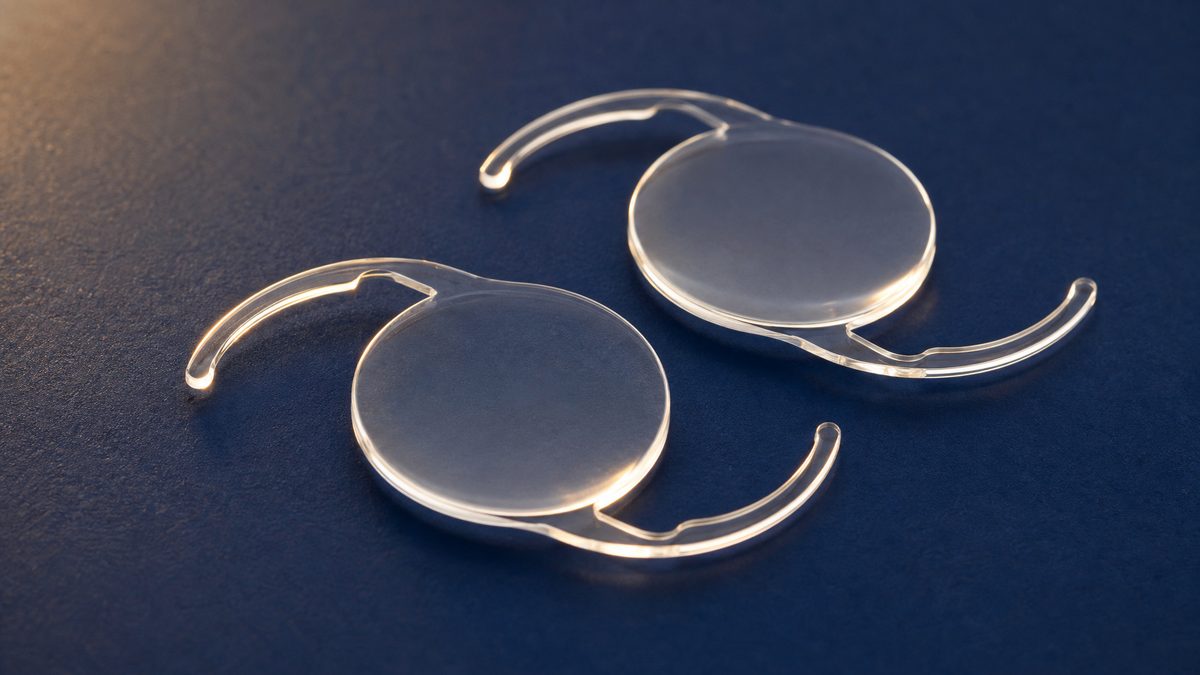
Eyhance and PureSee come from the same company, on the same lens platform, for the same patient: someone who wants clear distance vision and more useful arm's-length vision than a standard lens gives, without the halos of a trifocal. The Eyhance is a monofocal with a little extra range. The PureSee is an extended depth of focus lens, so it reaches closer, and it costs you a slightly higher chance of noticing a halo at night.
The short version
Both lenses give excellent distance vision, and the studies can't tell them apart there. In the trials, PureSee read two to three letters better than Eyhance at arm's length and up close, which is well under one full line on the chart. In one Korean series, 36% of PureSee patients used reading glasses, against 80% of Eyhance patients. A few more PureSee patients report halos or starbursts at night. Both lenses are still far below a trifocal on that.
| Eyhance | PureSee | |
|---|---|---|
| Lens class | Enhanced monofocal | Extended depth of focus (EDOF) |
| How it works | Gentle power rise toward the center, no rings | Continuous power change across the optic, no rings |
| Distance | Excellent | Excellent |
| Arm's length (computer, dashboard) | About a line better than a standard monofocal on average; varies patient to patient | Two to four letters better than Eyhance in the studies that measured it |
| Small print | Usually needs readers | Fine print usually needs readers; about 1 in 3 used them in the Korean series |
| Night halos and glare | No measured difference from a standard monofocal | Close to a monofocal; a few more reports than Eyhance in the trial |
| Contrast | Normal | Normal |
| Astigmatism version | Yes (toric) | Yes (toric) |
| Long-term data | Five years | Under one year |
| Best fit | Wants a monofocal with a little extra reach and no change in night vision | Uses arm's-length vision all day and accepts readers for fine print |
Two lenses from the same family
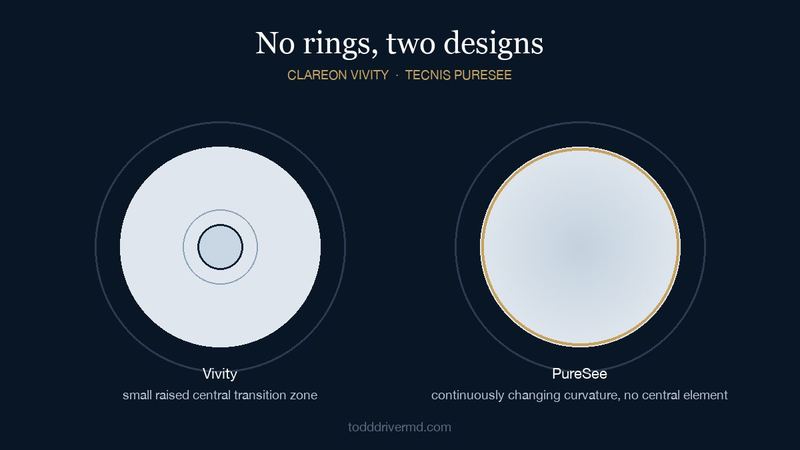
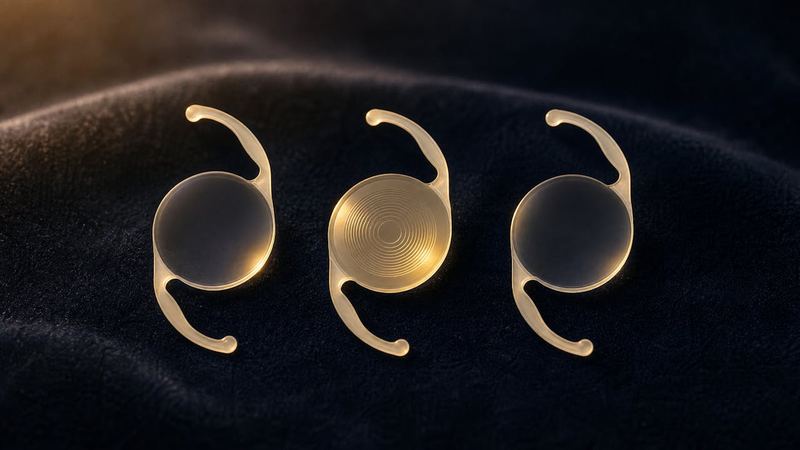
Both are one-piece TECNIS lenses, same material, same haptics, the little arms that hold the lens in place. The Eyhance is what the industry calls an enhanced monofocal: the lens power rises gently from the edge toward the center, which stretches the focus a little. It is classified as a monofocal. The PureSee is an extended depth of focus lens, an EDOF. The power changes continuously across the whole optic, with no rings and no central zone. In the published studies, PureSee patients keep useful vision from distance in to roughly 50 centimeters, about where you hold a phone, and Eyhance patients to roughly 80 centimeters, about a computer screen.
A trifocal has rings that split light into separate focus points, and those rings are what you see as halos around headlights at night. Neither of these lenses has rings, which is why neither behaves like a trifocal at night.
What the studies found
The head-to-head trial. The manufacturer's own randomized, masked trial put PureSee against Eyhance in 117 patients, both eyes, measured at six months. Distance vision was identical. At arm's length, PureSee read about two and a half letters better on the chart; up close, about three letters better. Contrast sensitivity, the ability to see a gray letter on a gray background, was the same. On night symptoms, 92% of PureSee patients said halos did not bother them or bothered them only slightly, against 98% with Eyhance, and starbursts and glare ran a few points the same direction.
Other surgeons' patients. Three groups in Korea and Germany have since compared the lenses in their own patients. Distance was equal in every one, and PureSee read two to four letters better at arm's length and up close in the two series that measured it. The Korean series also tracked who still used reading glasses: 80% of Eyhance patients did, and 36% of PureSee patients did. Those are two different groups of patients, so I hold that number loosely.
Eyhance's track record. Six years of trials against a standard monofocal, pooled in three separate meta-analyses, agree that Eyhance adds about one line of vision at arm's length, changes nothing at distance, and shows no measured increase in halos or glare and no loss of contrast. Its five-year follow-up shows the result holds. PureSee's data are newer, and nothing on it runs past a year yet.
How I counsel the Eyhance
When I recommend the Eyhance, I call it what it is: an enhanced monofocal lens. I never really promise intermediate vision for my patients, because sometimes it does give you good intermediate and sometimes it really doesn't, and I don't want to promise that and not be able to deliver it. The studies back that up. On average, Eyhance adds about a line at arm's length. Some patients get more than that and some get little. Pupil size is part of it: both of these lenses give more range when the pupil is small, so the same lens behaves differently in different eyes and in different lighting. So, what I tell my Eyhance patients is to expect excellent distance vision, plan on reading glasses, and treat any computer vision they get without glasses as a bonus.
How I counsel the PureSee
With the PureSee, I have been very impressed with this lens. I've had patients with very good intermediate and excellent distance, and they haven't really been reporting any glare or halos with it. I have been very pleased. The head-to-head trial adds one footnote my own patients haven't raised: a few more PureSee patients were bothered by halos than Eyhance patients were, about 8 in 100 versus 2 in 100, and starbursts and glare ran the same direction by a few points. In a separate post-approval study, PureSee's halo and glare profile was no worse than a standard monofocal's. So, I tell my patients about it before surgery.
The other thing I tell every PureSee patient is that this is not a reading lens. You will hold things a little further from your face, and for really small print, a pill bottle for example, most people still want readers.
Who each lens fits
So, here is how the decision usually goes in my office. If you want the cleanest possible distance vision and you don't mind reading glasses, a standard monofocal is still an excellent lens, and nobody should talk you out of it. If you would like a bit more range at arm's length and you're comfortable with the idea that it may or may not show up, the Eyhance is a reasonable step with no measured change in night vision. If arm's-length vision matters to you every day, the computer, the dashboard, the phone held out, and you accept readers for fine print, the PureSee is the one to talk through, knowing it carries a slightly higher chance of noticing halos.
There are patients I steer away from the PureSee. In my practice, I don't recommend an EDOF lens for patients who have macular degeneration, because your macular health and contrast sensitivity need to be as good as possible for these lenses to work properly for you. For those eyes, a monofocal, a toric, or the Light Adjustable Lens serves you better. The Eyhance can still be an option, and we decide that case by case. If you are weighing PureSee against Alcon's EDOF instead, I compared them in PureSee vs Vivity.
Common questions
Is the Eyhance an EDOF lens?
No. It is classified as a monofocal lens, with a modified surface that gives some patients extra range at arm's length. The PureSee is classified as an extended depth of focus lens.
Does the PureSee replace the Eyhance?
Not in my practice. They fit different patients. Eyhance is for someone who wants a monofocal with a little extra reach and no change in night vision. PureSee is for someone who wants more arm's-length vision and accepts a small chance of noticing halos.
Will I need reading glasses with the PureSee?
For small print, probably. In one Korean series, 36% of PureSee patients used reading glasses, compared with 80% of Eyhance patients.
Do either of these lenses cause halos at night?
Both are ringless lenses, and both have night-vision profiles close to a standard monofocal. In the head-to-head trial, 98% of Eyhance patients and 92% of PureSee patients said halos did not bother them, or bothered them only slightly.
Can I get either lens if I have astigmatism?
Yes. Both come in a toric version that corrects astigmatism at the same time.
Is PureSee too new to trust?
The FDA approved it in March 2026 after a randomized trial, and it was studied and used outside the United States before that. What it does not have yet is long-term data. Eyhance has five years of follow-up; PureSee has under one.
Sources: Corbett et al., Eye 2024, randomized PureSee vs Eyhance trial · Black et al., Eye 2024, tolerance to refractive error, same trial · Kim et al., J Clin Med 2025, PureSee vs Eyhance, 100 eyes · Son et al., Sci Rep 2026, PureSee vs Eyhance on the same platform · Lee et al., Sci Rep 2026, PureSee with a myopic target vs Eyhance · Son et al., J Refract Surg 2025, optical bench comparison of TECNIS lenses · Wan et al., J Refract Surg 2022, enhanced vs conventional monofocal meta-analysis · Fernandez et al., Eye 2025, systematic review and meta-analysis · Loh et al., Can J Ophthalmol 2026, RCT meta-analysis · Mencucci et al., J Clin Med 2025, Eyhance five-year follow-up · Auffarth et al., Clin Ophthalmol 2026, PureSee post-approval study · Alfonso-Bartolozzi et al., J Refract Surg 2025, PureSee optics and range · Garcia-Bella et al., J Cataract Refract Surg 2024, bilateral Eyhance range
Related reading: PureSee vs Vivity · comparing premium cataract lenses · who should not get a multifocal or EDOF lens · cataract lens options explained · or see how each lens looks in the simulator.
Deciding between these two lenses?
Tell me how far you sit from your screens and whether you drive at night, and we'll pick the lens together at OC Eye Associates, Irvine.
Call (949) 653-9500Read next
This article is for educational purposes and is not a substitute for a medical examination or personalized medical advice. Lens choice depends on your eye measurements, your eye health, and how you spend your day; discuss it with your own surgeon.