Light Adjustable Lens Lock-In: What It Is and When It Happens
Published August 5, 2026 · Updated September 30, 2026 · Medically reviewed by Todd Driver, MD
Quick answer: Lock-in is the final step of the Light Adjustable Lens process. Once your prescription is where you want it, two lock-in light treatments, spaced one week apart, make the lens permanent so it can never change shape again. The UV glasses come off for good 24 hours after the second lock-in.
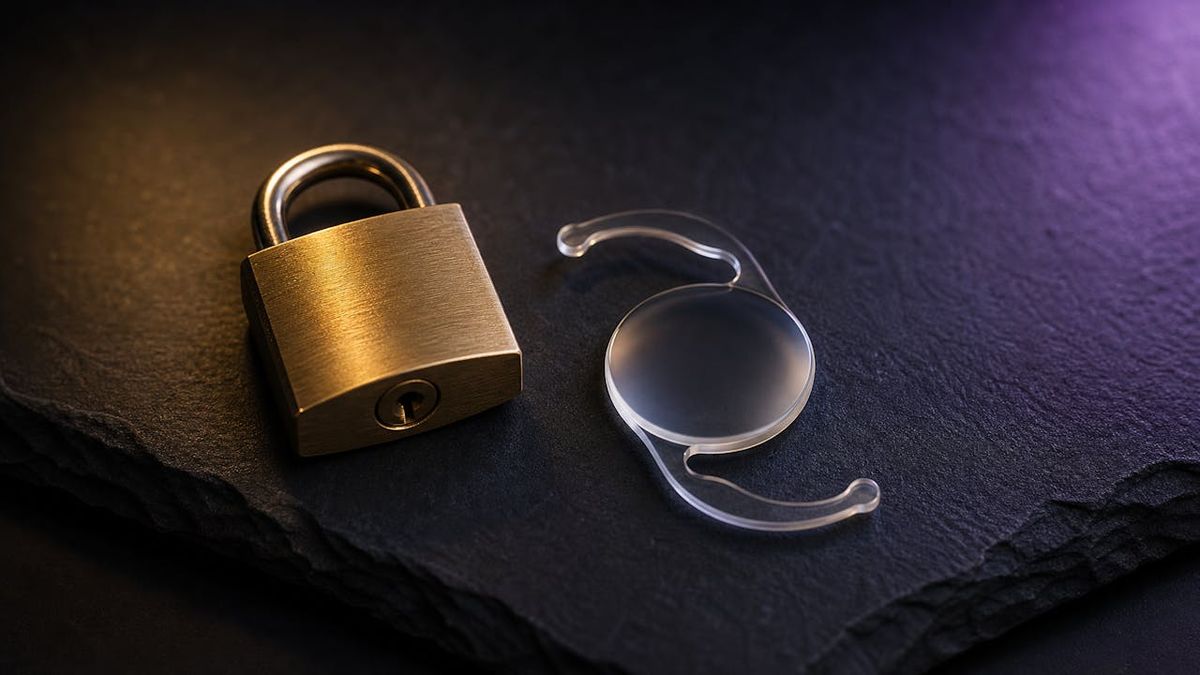
Why lock-in exists
The LAL is adjustable because its material responds to a specific wavelength of UV light, which is the whole basis of the Light Adjustable Lens procedure I offer in Irvine. That's a great property while we're fine-tuning your vision, and a bad one to leave open-ended for the rest of your life. Lock-in uses up the remaining light-sensitive material in the lens so no further change is possible, intended or otherwise.
What the appointments are like
In my practice, lock-in happens after your adjustments are done, which usually falls a couple of months after your second eye's surgery, since adjustments don't begin until four weeks after that eye and each one needs time in between. There are two lock-in treatments, one week apart, each its own appointment. The treatment itself feels like an adjustment: dilating drops, a few minutes at the light delivery device, and you're done. Nothing is implanted or removed.
The question I get most: "Can I change my mind later?"
No, and that's the point. Lock-in is the trade where you give up adjustability in exchange for permanence. This is why we don't rush it. If you're still on the fence about your near vision target, we talk about it before lock-in, not after. In the published registry, more than half of patients changed their target prescription during the adjustment period after living with their vision for a while. That's exactly what the window before lock-in is for.
What happens to my lens and glasses after lock-in?
The glasses come off 24 hours after the second lock-in, the lens is permanent, and from that point the LAL behaves like any other implanted lens. The lens itself has nothing to maintain and nothing that wears out.
Sources: FDA premarket approval P160055, summary of safety and effectiveness · Doane et al., clinical data registry of two light adjustable lenses (J Cataract Refract Surg 2025)
Related reading: The Light Adjustable Lens, explained · How many adjustments you get · The UV glasses, explained · LAL vs LAL+: what changed · or the Light Adjustable Lens in Irvine.
Two tools that may help you think this through: the 60-second lens quiz, and the vision simulator, which shows how each lens sees by day and at night.
Curious whether you're an LAL candidate?
It takes one consultation to find out. OC Eye Associates, Irvine.
Call (949) 653-9500Read next

This article is for educational purposes and is not a substitute for a medical examination or personalized medical advice. Timelines describe my own practice and can differ between surgeons.