Should You Wait for the New Lens Before Cataract Surgery?
Published November 9, 2026 · Medically reviewed by Todd Driver, MD
Quick answer
If your cataract is affecting your vision, I don't think it's worth waiting for a new lens. The accommodating lens that's furthest along, OmniVu, isn't FDA-approved yet. In its first study, 14 eyes were followed for three years and on average could see far away and read a phone without glasses, but it still needs much bigger studies, and no one knows when it will be approved. And if you wait and the cataract gets very dense, it's harder and riskier to remove. If your cataract isn't bothering you yet, waiting is reasonable.
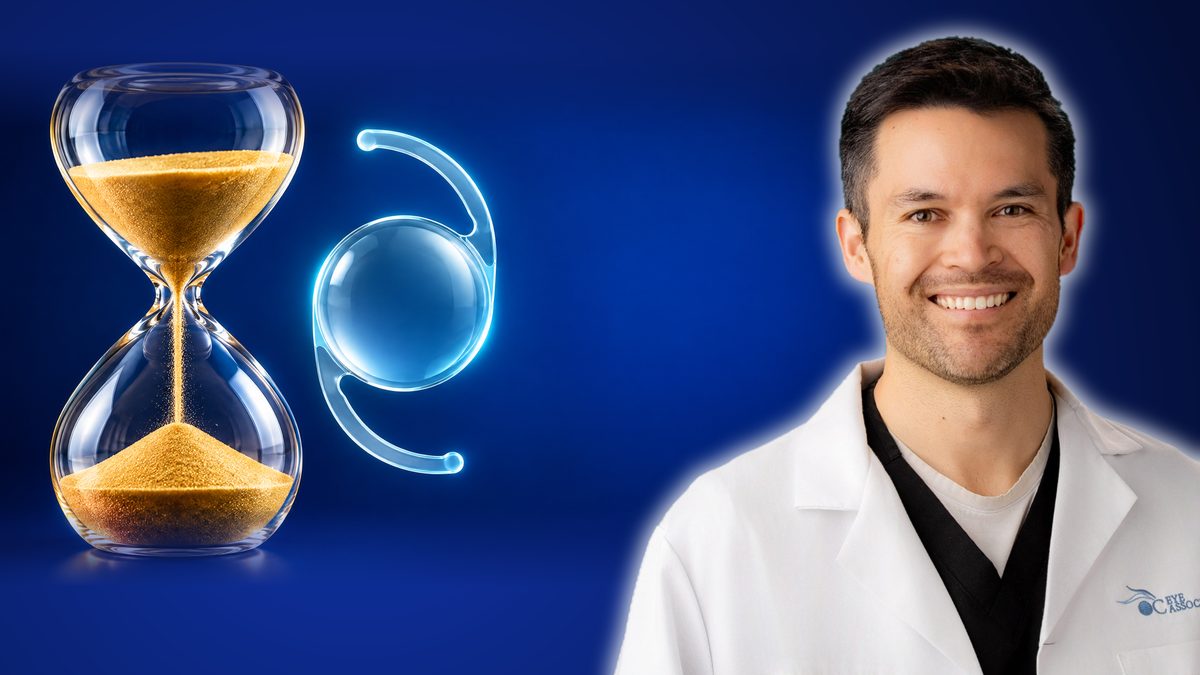
I've had patients come in seeing 20/30, not really driving at night anymore, who tell me they don't want surgery because they want to see if something better comes along in the future. A few years later, they often can't pass the vision test for their driver's license, their cataract is extremely dense, and we have to do the cataract surgery at that point anyway.
Should you wait if your cataract is affecting your vision?
If a cataract is actually affecting your vision, what I tell my patients is that it's not worth waiting for a new lens to come out, because no one knows exactly when that will be. The lenses we have right now are very good. If you wait, you're giving up years of good vision in the hope of something we don't even know is going to happen.
What if your cataract isn't bothering you yet?
If your cataract really isn't bothering you, it's reasonable to wait. I like to hold off on surgery until you're feeling more of the symptoms from your cataract. Technology does keep improving, and there may be some better lenses out by then. I don't know when they'll come out. Maybe five years, maybe more, maybe less.
What is the risk of waiting for cataract surgery?
The main risk is that the cataract can become more challenging to remove, and the surgery can become more risky if the cataract gets very advanced. A dense cataract takes more energy to remove, which puts more stress on the eye. It's kind of like the difference between scooping out soft ice cream and chipping away at a frozen block.
Eventually, the patients who fail the vision test for their license can't wait anymore, and they get the surgery. In my experience, even if a nicer lens comes out two years later, their cataract surgery is such a huge improvement that they tell me, “Man, I really wish I didn't wait to get this, because I can see so much better right now.”
What is the new lens that focuses like a young eye?
When you're young, the lens inside your eye can change shape to focus up close and far away. We call this accommodation. In your forties that lens gets stiffer, which is why you start needing reading glasses. The lenses we put in during cataract surgery today can't change their focus on their own like that.
The new lens you may have been seeing online is designed to change shape inside your eye the way your natural lens did when you were young. The one that's furthest along is called OmniVu. In its first study, 14 eyes were followed for three years, and on average those eyes could see far away and read a phone without glasses. That's truly a remarkable result, but it's only been done in 14 eyes, and it still has to go through bigger studies before the FDA approves it. Those bigger studies are just getting started. The FDA gave the company the go-ahead for a US trial in 2025.
What happened to the Crystalens?
There was an accommodating lens that came out called the Crystalens. It was supposed to flex with your eye muscles, and it did work in some patients. But as the lens was in the eye for a longer period of time, there were issues with the capsule that holds the lens contracting. That could cause the lens to get smushed and crunched and become misaligned, and then it wouldn't work very well. That's why I want to see how the new lens holds up in a lot more eyes over a lot more years.
What if your lens power ends up off target?
If your lens power ends up a little bit off target, it usually can be fixed. About 80% of eyes with traditional lens formulas land on target. The rest are a little bit off, and that's something we can fix surgically if it's really important to you. Most people aren't bothered by it, because being a little bit off target still gives you very good vision.
With the light adjustable lens, which I use a lot in my practice, we can adjust the power of the lens after your eye heals. That gets about 90 to 95% of eyes within about half a diopter of target, which is very, very good. In the FDA trial of the light adjustable lens, 92% of those eyes ended up within half a diopter of target, compared with 83% of the eyes that got a standard lens. I have no financial relationship with RxSight, the company that makes it.
Is a lens with a swappable front piece better?
The new OmniVu lens has a separate front piece that a surgeon can swap out if the power is off. If I had to choose between that and a light adjustable lens, I would choose the light adjustable lens, because any time you go back inside the eye to do anything, it introduces risk. The light adjustable lens is adjusted from outside the eye. You just shine a light on it and it changes shape.
The downside is that the light adjustable lens takes several visits after surgery, and you have to wear special UV glasses until we're done adjusting it and the lens is locked in.
Can any lens give you back the vision you had in your twenties?
In my opinion, not yet. The light adjustable lens doesn't truly accommodate by changing shape when you look at different distances, and its range of focus is limited even after the adjustments. But it's still very good. If we truly get an accommodating lens that can replicate the vision you had as a 20-year-old, that would be better than the light adjustable lens. I'm not sure that technology is proven yet.
What would I tell my own dad?
So if my own father was happy with his vision, still driving at night, and not having any problem with his glasses, I'd tell him he can wait for cataract surgery. But if his vision was going downhill and I looked in his eye and saw a big cataract, I'd say, “Dad, just go get your cataract surgery, because the existing technology we have right now is very good.”
Common questions
Is the OmniVu lens FDA-approved?
Not yet. Its first study followed 14 eyes for three years, and those eyes did very well for distance and reading, but the lens still has to go through bigger studies before the FDA can approve it.
When will the new accommodating lens be available?
No one knows exactly when. The FDA gave the go-ahead for a US trial in 2025, and trials like that take years. That's why I don't recommend putting off surgery for it if your cataract is already affecting your vision.
Should I wait for a better lens before cataract surgery?
If your cataract is affecting your vision, I tell my patients it's not worth waiting. If it isn't bothering you yet, it's reasonable to hold off until you're feeling more of the symptoms.
What is the risk of waiting too long for cataract surgery?
A very dense cataract takes more energy to remove, which puts more stress on the eye and can make the surgery more risky.
What if my lens power is off after cataract surgery?
Most people who are a little bit off still see very well, and it can usually be fixed if it bothers you. With the light adjustable lens, we adjust the power after your eye heals.
Sources: OmniVu first-in-human three-year results and the 2025 US trial go-ahead, Ophthalmology Times, April 2026 (ASCRS 2026 meeting abstract, Wiley et al.) · FDA Summary of Safety and Effectiveness Data for the Light Adjustable Lens, P160055
Related reading: when is it time for cataract surgery? · the light adjustable lens · what happens if your lens power is off · comparing premium cataract lenses · or see what cataract surgery in Irvine involves.
If you're thinking about cataract surgery, there's the 60-second lens quiz and the vision simulator, which shows how each lens sees by day and at night.
Not sure if it's time for your cataract surgery?
Come in and we'll look at how much your cataract is affecting you. My office is at OC Eye Associates in Irvine.
Call (949) 653-9500Read next


This article is for educational purposes and is not a substitute for a medical examination or personalized medical advice. The OmniVu lens is investigational and not FDA-approved. When to have cataract surgery depends on your eyes. Follow the plan your own surgeon gives you.