The 5 Questions I Wish Every Patient Asked Before Cataract Surgery
Published September 4, 2026 · Medically reviewed by Todd Driver, MD
Quick answer: At your pre-op visit, ask five things. Has your surgeon treated cataracts like yours, and do they feel confident about your case? What would they choose for their own eye, or their mom's, with money out of the equation? Which lens fits how often you are willing to wear glasses? Is there anything about your eyes that rules out certain lenses? And if your vision does not land where planned, what would the fix be: glasses, a laser touch-up, a lens exchange, or an adjustment with the Light Adjustable Lens?
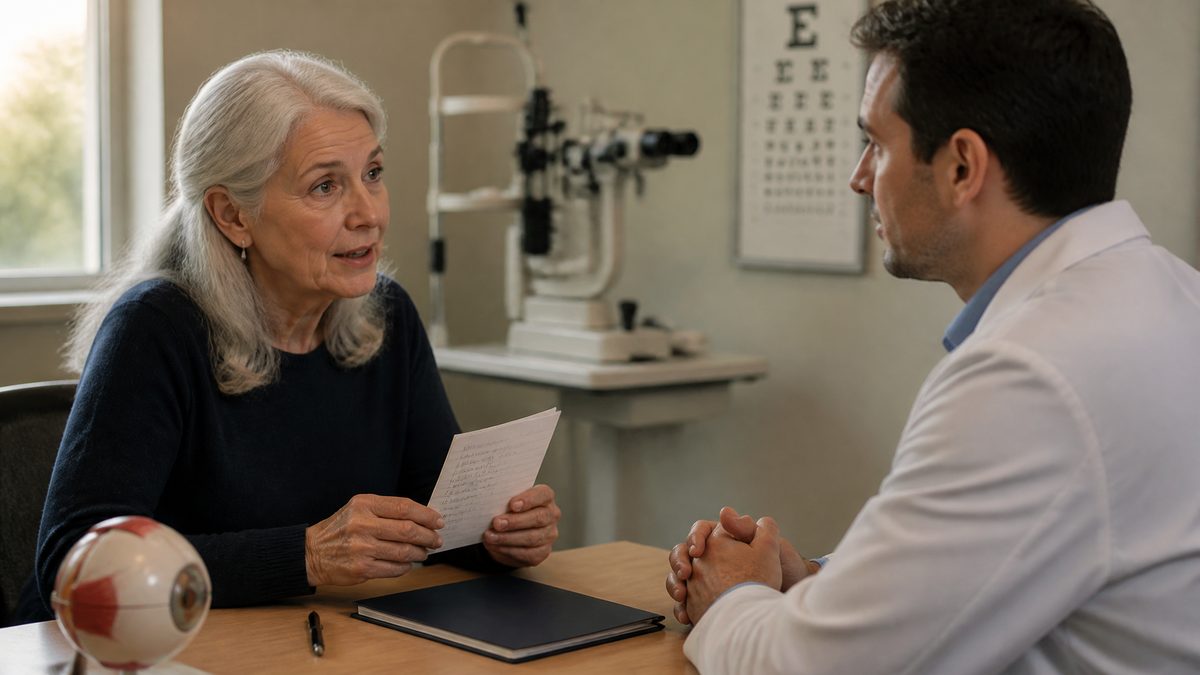
The first question on this list sounds almost rude: are you confident doing my surgery? Ask it anyway. A good surgeon will not be offended, and the answer tells you more than anything else you will hear at your pre-op visit. The other four questions decide which lens goes in your eye and what happens if the result is not what we planned.
1. Have you treated cataracts like mine, and do you feel confident about my case?
This gives your surgeon an out. If your eye is very complicated and the surgery would be really challenging, and your surgeon does not feel comfortable doing it, you probably want them to refer you to another surgeon, or to a surgeon at an academic center, where they are used to dealing with really complicated cataracts.
You might think no surgeon is going to look you in the eye and say no. I actually would not say that is true. A good surgeon knows their limits, and this is a very simple question to ask. It gives the surgeon a way out if they are feeling a little bit borderline about the case. I would rather have a surgeon who is confident in my case than someone who is kind of on the edge of whether they should take my case or not.
2. If this were your eye, or your mom's eye, what would you do, with money out of the equation?
I tell my patients to put it to me exactly that way. Cost is a real part of this decision, and we will talk about it. It belongs in the second conversation, though, after you have heard what your surgeon would pick for your eye on the medicine alone. If you want my thinking on the cost side, I wrote about it in the post on whether the Light Adjustable Lens is worth it.
3. How often am I willing to wear glasses?
If you are okay wearing reading glasses every once in a while, that will dictate what sort of lens you can get. If you are wearing glasses all the time, that also will dictate what sort of lens you get. And if you really want to not wear glasses, you should think about whether activities that need a lot of depth perception matter to you, like playing tennis or pickleball.
We have two ways of getting you near and far vision. One is monovision, where one eye is set for far and one eye is set for near. It works, but it comes at the expense of your depth perception. Your brain judges distance by comparing the picture from both eyes, the same reason it is hard to thread a needle with one eye closed. Set the two eyes to different distances and the brain has less to compare. I have had patients who play tennis who got monovision and are not big fans of it, because they have a hard time judging where the tennis ball is in space.
A patient like that is a better candidate for the second route, a range-of-focus lens in both eyes: an extended depth of focus lens (an EDOF lens) in both eyes, a trifocal in both eyes, the Light Adjustable Lens (the LAL+) in both eyes, or mixing and matching between them. The lens quiz on this site walks you through these same questions.
4. Do I have any eye conditions that rule out certain lenses?
When a patient asks me this, I am mainly checking four things: how wide your pupil dilates, macular degeneration, a retinal membrane (a thin layer of scar tissue on the surface of the retina, which doctors call an epiretinal membrane), and glaucoma. Those are the main ones.
In my opinion, macular degeneration, glaucoma that has affected your vision, and a retinal membrane rule out the EDOF and trifocal lenses. Those lenses split or stretch the light coming into your eye, and they only work well if the rest of the visual system is healthy enough to make use of it. Poor pupil dilation rules out the laser, and it also rules out the Light Adjustable Lens, because your pupil has to dilate large enough to enable the light treatments that adjust the lens after surgery. Ask, and get the answer before a lens is chosen.
5. What do we do if my vision does not end up as planned? What is the fix?
Cataract surgery can go perfectly and still leave you more nearsighted or farsighted than planned, because the lens power missed its target. It affects roughly one in five patients to some degree. The fixes are glasses, a laser touch-up, exchanging the lens, or, if you chose the Light Adjustable Lens, an adjustment in the office. Which of those your surgeon would reach for depends on your eye and the lens you chose, so hear the plan now. I wrote about this in more detail in the post on refractive surprise after cataract surgery.
If it were my mom sitting in that chair, these are the five questions I would want her to ask, in this order. Bring them with you. If you are coming to see me, ask me all five, and if you would rather start with a phone call, request a callback and the office will set it up.
Related reading: how surgeons actually choose your lens · who should not get a multifocal or EDOF lens · refractive surprise after cataract surgery · all four cataract lens options compared · cataract surgery in Irvine · or call to arrange a cataract consultation in Irvine. · what happens at your first visit
Two interactive tools can help you compare your options: take the 60-second lens quiz or see each lens in the vision simulator, day and night.
Want to ask me these five in person?
Bring the list to a consultation at OC Eye Associates, Irvine.
Call (949) 653-9500Read next

This article is for educational purposes and is not a substitute for a medical examination or personalized medical advice. Candidacy for any lens is determined at consultation.