How Surgeons Actually Choose Your Cataract Lens Implant
Published July 31, 2026 · Updated September 21, 2026 · Medically reviewed by Todd Driver, MD
Quick answer: Your lens is chosen from measurements, not preference: corneal mapping, an eye-length scan, and a retina check, run through formulas that predict lens power. Your priorities decide the lens family; the measurements decide whether your eye qualifies.
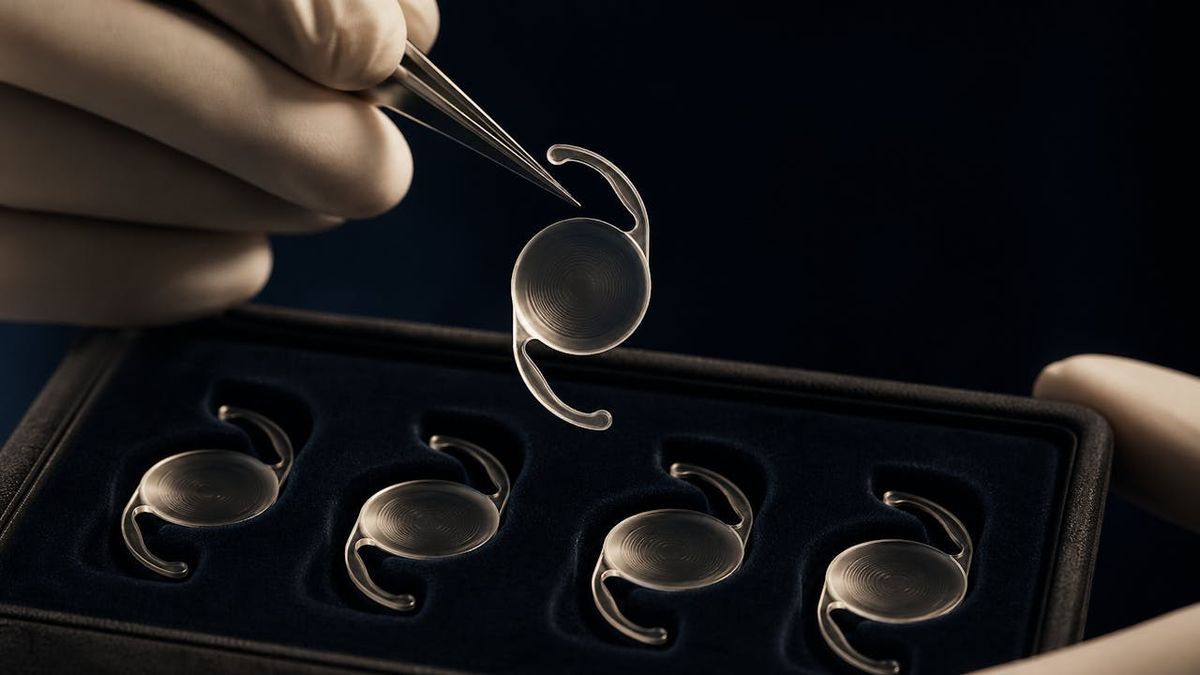
One of the best questions I've been asked in my office this month was, "How do you actually choose the lens that goes in my eye?" And the part that surprises almost everyone: sometimes we change that decision in the middle of your surgery. You should understand how the decision for what lens gets put in your eye gets made, so here it is, step by step.
Step one: mapping your cornea
After you say yes to surgery, I schedule you for a measurements appointment. The first thing we do is map the cornea, using topography and a Pentacam. This matters because the shape of your cornea dictates what sort of lens is the best fit for your eye. If your cornea is more spherically shaped, like a golf ball, then the basic lens is a totally reasonable option. But if you have a lot of astigmatism, meaning your eye is more football-shaped, you'd probably want a lens with astigmatism correction built in: a toric lens, or among the premium options, a multifocal or Light Adjustable Lens. If you have significant astigmatism and choose the basic lens, your vision will still improve, but you'll need glasses to reach full correction, because the basic lens doesn't correct astigmatism.
Mapping is also how we check that your astigmatism is what we call regular astigmatism. If you have irregular astigmatism, your eye's surface is unevenly shaped, and that rules some lenses out entirely; a multifocal lens would not work at all. Some lenses handle irregular astigmatism better, such as the Light Adjustable Lens, but honestly, with irregular astigmatism it's very hard to reach 100% full correction with cataract surgery alone.
Step two: biometry and the prediction formulas
Next comes biometry, which measures your corneal curvature, your anterior chamber depth (the depth of the front of your eye), and your axial length (the length from the front to the back of your eye). We plug all of that into IOL prediction formulas, sophisticated formulas that predict which lens power will be the best fit for your eye.
Here's what patients don't realize: these formulas are very accurate, but they're still educated predictions. And the more information we have, the more accurate those predictions become.
Step three: the double-check during surgery (ORA)
One thing I like to do to increase the accuracy of my lens selection is use a device called ORA. It's not covered by insurance, so it's an extra out-of-pocket cost, but I generally recommend it in almost all cataract surgeries, because more information makes my lens selection more accurate, and there are studies showing ORA increases the accuracy of lens selection.
Here's how it works. During surgery, after I've removed your cloudy lens, ORA, which attaches to my operating microscope, measures your eye. It either agrees with what my clinic biometer told me to use, or it tells me to switch the lens. If it says switch, I simply take a different lens off the shelf and implant that one instead.
How often does the lens actually change?
In my experience, ORA suggests a lens change about 10 to 15% of the time in eyes that have never had surgery, and about 25% of the time in eyes that had LASIK, PRK, or RK years ago. Choosing lenses for post-refractive-surgery eyes is difficult because those procedures surgically altered the shape of the cornea, which throws off the accuracy of the prediction formulas. Despite many very smart people working on formulas for post-LASIK eyes, none are as accurate as the traditional formulas are in eyes that never had refractive surgery.
I've had ORA suggest some fairly substantial changes in lens power, and it was the difference between a patient seeing 20/20 after surgery without glasses and a patient needing glasses to pass the driver's exam.
Is ORA worth it?
I think so, especially for patients with prior LASIK or PRK; in those eyes it makes lens selection much more accurate, and I strongly encourage it. Even in eyes without prior surgery, I find it helpful: there are eyes where I'd have no idea whether ORA would matter, and in the cases where it does suggest a switch, it's generally the correct one and the patient sees better as a result. Patients sometimes ask, "Doc, what would you do for your own eyes?" If I were having cataract surgery, I would absolutely use it, because I've seen the cases where it made a significant difference, and the trade-off is cost, not safety. The downside is the out-of-pocket expense.
There is one case where you don't need ORA: the Light Adjustable Lens. If that lens lands off target, we can adjust it after surgery, something no other lens allows. When my patients are candidates for the Light Adjustable Lens, that adjustability is the reason I bring it up first.
Does the average patient need all of this?
It depends on whether you care about wearing glasses after surgery. If you don't mind glasses when the lens lands a little off target, ORA doesn't matter very much. But if you want to maximize your chance of being glasses-free, which is exactly what people choosing premium lenses are hoping for, then I definitely think it's worthwhile.
In summary: the corneal maps tell us which lenses your eyes qualify for, the biometry predicts which lens power to use, and ORA double-checks that prediction during surgery, while we can still change our mind, before the lens is permanently implanted. These are all educated predictions, but they're made far more accurate by the topography, the biometry, and ORA together.
I do this surgery week in and week out. For most of my patients, it happens once in a lifetime. That lens implant is something you'll be looking through 100% of the time you're awake, and getting it right can make a very big improvement in the quality of your life.
Related reading: cataract surgery in Irvine · is ORA worth it? An honest review · why lens targets get missed · the Light Adjustable Lens at our Irvine practice · the five questions to ask your cataract surgeon · or call to arrange a cataract consultation in Irvine.
Two interactive tools can help you compare your options: take the 60-second lens quiz or see each lens in the vision simulator, day and night.
Want your lens chosen with every tool available?
Advanced measurements and honest recommendations. Schedule with Dr. Driver at OC Eye Associates in Irvine.
Call (949) 653-9500Read next


This article is for educational purposes and is not a substitute for a medical examination or personalized medical advice.