Too Dry for Cataract Surgery? Why Your Surgeon May Wait a Few Weeks
Published November 4, 2026 · Medically reviewed by Todd Driver, MD
Quick answer
Dry eye can make the measurements for your lens inconsistent, because a dry patch in your tear film blurs the surface the measuring machines read. When I see that, what I typically do is treat the dry eye first, with punctal plugs and preservative-free artificial tears, plus prescription drops and warm compresses if the oil glands in your eyelids need it. Then I measure again in a few weeks, so we can have more confidence that the lens we choose is the correct one.

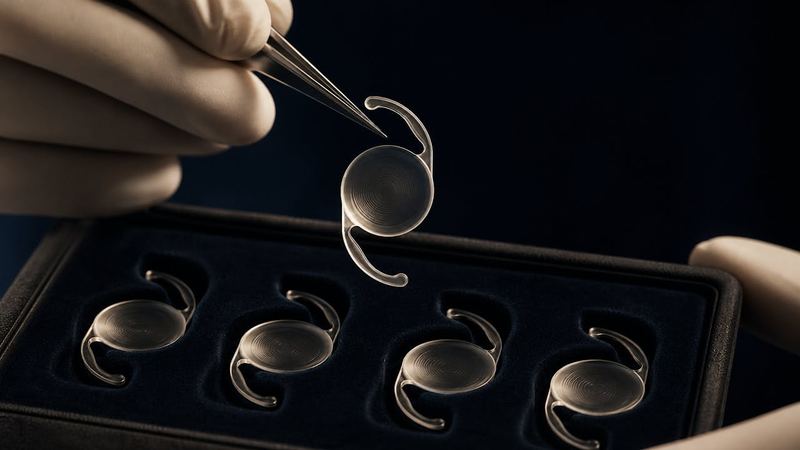
Sometimes a patient is ready for cataract surgery, and I tell them we need to wait a few more weeks. The cataract isn't the reason. Their eyes are too dry for me to measure them accurately, and the measurements are what decide which lens goes inside your eye.
When I'm doing the measurements for your lens, I actually do them myself, and I can tell when the quality of the measurements is not good.
How does dry eye throw off cataract measurements?
There's normally a layer of tears that's supposed to cover your cornea, a nice uniform layer, and light passes through it first. If there's a disruption in that tear film, such as a dry patch, it can significantly blur the image, and the machines that measure your eyes aren't reading the surface correctly.
On the measurements I'll see odd amounts of astigmatism or a cornea that looks irregular, and the lens calculations won't agree from one reading to the next. So when I see that, I tell the patient that the dryness is really affecting the quality of my measurements and making them very inconsistent. Because of that, my ability to choose your lens accurately is not going to be very good.
Can you have cataract surgery if you have dry eye?
Yes, you can have cataract surgery if you have dry eye. I just think it's best to optimize your dry eye before we do the measurements, because the measurements are how we choose the lens that will give you the vision you get afterwards.
A lot of patients have been waiting a long time for their cataract surgery, so they ask me, “Why can't we just do it now?” Most of my patients understand. They just want to make sure they can get the correct lens, because I tell them that once the lens is in your eye, we don't want to take it out. Taking the lens out and replacing it is a risky procedure, so I want the measurements as accurate as possible before we make the final decision to put the lens in.
Can you have dry eye and not feel it?
Sometimes people don't know what dryness feels like. They may honestly not feel anything. But if your eyes feel tired at the end of the day, that can be dryness. If it feels like there's something in your eye, that can also be dryness. And if you feel like you have to blink a lot to see clearly, that's probably also dryness.
If your eyes are already dry to begin with, your corneas may not have enough sensation to trigger tear production, and that's another reason people may not feel dry when their eyes are actually very dry. In one study of patients getting ready for cataract surgery, only about one in four had no signs of dry eye at all. Another study of cataract patients found that the ones whose tear testing pointed to dry eye had less consistent corneal readings from one visit to the next, and whether a patient said they had dry eye didn't predict it.
How is dry eye treated before cataract surgery?
So what I typically do is put small plugs in the tear drains of your eyelids, which are called punctal plugs. They keep your natural tears in your eyes longer, so your eyes stay more moisturized.
I also tell my patients to put preservative-free artificial tears in their eyes about every two hours while they're awake, which is very frequent, and you have to do it very consistently.
If the oil glands in your eyelids aren't working well, which is called meibomian gland disease, we can also put you on a short course of steroid drops or a longer course of an anti-inflammatory drop, such as cyclosporine. Then we have you do warm compresses to try to get the oil glands producing better quality tears, because when your tears have oil in them, they don't evaporate as quickly.
How long will my cataract surgery be delayed?
So generally, I bring you back in a few weeks. Assuming you're following the protocol, your surface will look better and I can remeasure. If the map of your cornea, which is called corneal topography, is a better quality reading, then we can move forward with planning your cataract surgery.
If your cornea still isn't looking well moisturized, we can do more advanced things before surgery, such as an amniotic membrane treatment, and then do the measurements again after that. Amniotic membrane is donated placental tissue that has been processed and sterilized, and it's commonly used in surgery to help with wound healing. We place it on the cornea and it dissolves, and generally we find it helps the cornea smooth over and helps with dryness too.
Can treating dry eye change which lens you get?
So I've had cases where treating the dryness made a dramatic change in which lens was recommended. I had one patient where the first measurement showed his cornea was really lumpy and bumpy and didn't have any regular shape to it. Based on those measurements, a lens that corrects astigmatism, which is called a toric lens, would not have been a good option for him, because it would not have treated his astigmatism adequately.
After we got his dryness under better control, we found he actually had a regularly shaped cornea with a regular pattern of astigmatism. We put a toric lens in, and he's now seeing 20/20 after surgery.
Does dry eye cause blurry vision after cataract surgery?
When a patient has blurry vision or persistent glare after cataract surgery, by far the most common cause is dry eye, at least in my clinic. That's a big reason screening for dry eye before surgery is very important. If you've already had surgery and your vision is still blurry, I go through the other causes in my post on blurry vision after cataract surgery. At any point, sudden loss of vision, real pain, or a red eye is a same-day call.
Will cataract surgery make my dry eye worse?
Anytime you do surgery on the eye, it tends to affect the tear film. A lot of my patients find their dry eye gets a little bit worse after cataract surgery, at least temporarily, but as your eye recovers from the surgery, the dryness tends to return to the way it was beforehand. If you're struggling with dryness after surgery, work with your cataract surgeon, because there are things we can do to help your recovery go more smoothly.
Can you get a trifocal lens if you have dry eye?
Sometimes. A trifocal is a lens that can give you distance, computer and reading vision, and it's very sensitive to dryness. Let's say you have really dry eyes, and we can't get the surface adequately lubricated before surgery, despite aggressive measures. Then certain lenses, such as the trifocal, may not be a good option for you. I go through who should skip these lenses in who should not get a multifocal or EDOF lens.
Is it worth waiting a few extra weeks?
If you've been told your eyes are too dry for surgery right now, ask your surgeon what they saw on your measurements and when they plan to measure again. In my office it's usually a few weeks. I definitely think it's worth waiting a few extra weeks, because the lens your surgeon chooses is something you're going to be looking through 100% of the time while you're awake.
Common questions
Can I have cataract surgery if I have dry eye?
Yes. I just think it's best to optimize your dry eye before we do the measurements, because the measurements are how we choose the lens that will give you the vision you get afterwards.
Do I have to treat dry eye before cataract surgery?
It depends on what the measurements look like. If the dryness is throwing them off, I treat it first and measure again, because the measurements decide which lens goes in your eye.
How long does dry eye treatment take before cataract surgery?
I usually bring patients back in a few weeks. If the surface looks better and the map of the cornea is a better quality reading, we move forward. If not, there are more advanced treatments, and we measure again after those.
Will cataract surgery make my dry eye worse?
It tends to make it a little bit worse, at least temporarily. As your eye recovers from surgery, the dryness tends to return to the way it was beforehand.
Can dry eye affect whether I get a toric lens?
Yes. Dryness can make a cornea look irregular, which can make a toric lens look like a poor option. In one of my patients, treating his dryness made a dramatic change, and he ended up with a toric lens.
Can I get a trifocal lens if I have dry eye?
It depends on whether we can get your eye surface well lubricated before surgery. The trifocal is very sensitive to dryness, so if we can't, it may not be a good option for you.
Sources: Trattler et al., the PHACO study, Clinical Ophthalmology, 2017 · Epitropoulos et al., tear osmolarity and repeatability of keratometry for cataract surgery planning, Journal of Cataract and Refractive Surgery, 2015
Related reading: did my cataract come back? (PCO) · how surgeons choose your cataract lens · blurry vision after cataract surgery · who should not get a multifocal lens · when the lens misses its target · your first visit · or take the lens quiz.
If you're thinking about cataract surgery, there's the 60-second lens quiz and the vision simulator, which shows how each lens sees by day and at night.
Getting ready for cataract surgery?
I do the lens measurements myself, and if dryness is throwing them off, we'll get your eyes ready first. My office is at OC Eye Associates in Irvine.
Call (949) 653-9500Read next

This article is for educational purposes and is not a substitute for a medical examination or personalized medical advice. How dry eye is treated before surgery depends on your eyes and your measurements. Follow the plan your own surgeon gives you.