Why Your Eye Flashes After Cataract Surgery: The Cat-Eye Glint Explained
Published July 21, 2026 · Updated September 22, 2026 · Medically reviewed by Todd Driver, MD
Quick answer: That flash in the eye after cataract surgery is a reflection off the artificial lens implant. It doesn't affect vision at all, and most people never notice their own. Which lens your surgeon picks makes it dramatically brighter or nearly invisible, so if you'd care, bring it up before surgery.
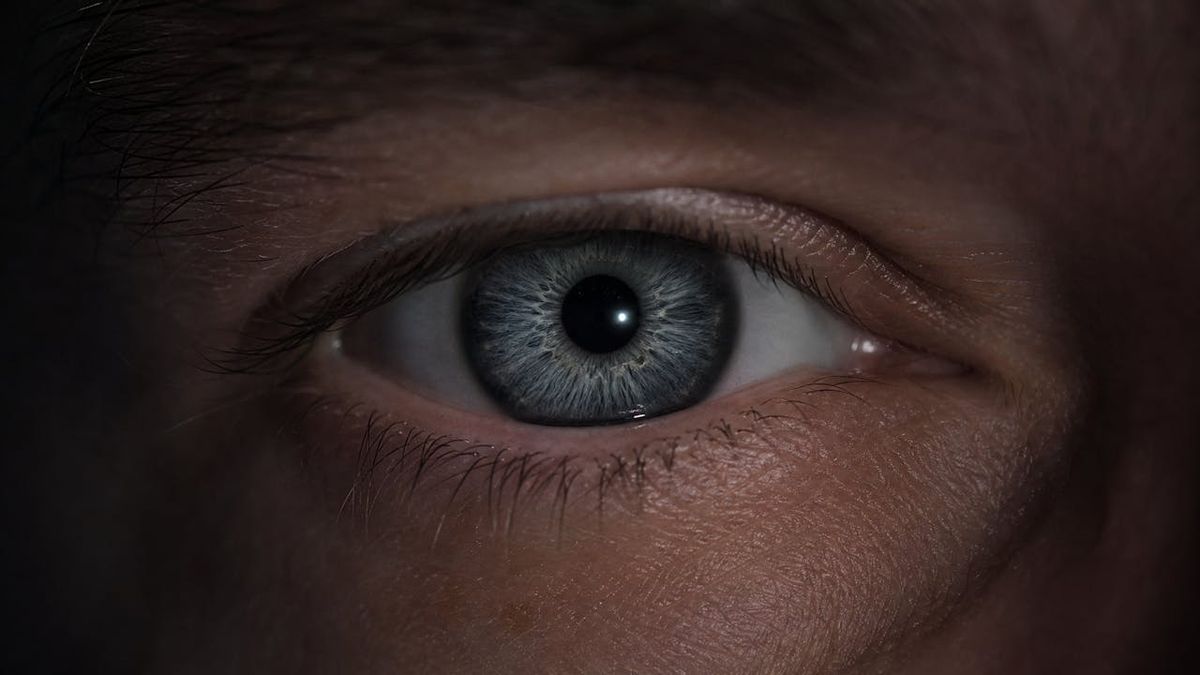
Have you ever noticed a strange glint, a flash, a shimmer in someone's eye after they've had cataract surgery? Almost like a cat's eye catching the light at night. That glint is real, and it's caused by the artificial lens inside the eye. Which lens your surgeon picks can make it dramatically brighter or almost invisible.
Quick reassurance before we start, because I don't want to scare anyone: this glint doesn't affect your vision at all, and most people never notice it. But if you're someone who'd care, and by the end of this article you'll know if you are, the time to deal with it is before surgery.
What the cat-eye effect actually is
It's an optical glint. Other people notice a bright flash or shimmer in your pupil under certain lighting; you usually can't see it yourself. It shows up in photos, under restaurant lighting, in headlights. Family members are often the first to point it out: "Your eye just flashed." It's purely a reflection and has nothing to do with how well you see.
But here's the puzzle: you had a lens in your eye your whole life, and it never flashed at anyone. So what changed on surgery day?
Why an artificial lens reflects more light
Every surface inside your eye reflects a tiny bit of light. Your cornea does it; that's the sparkle you see in everyone's eyes. Your natural lens does it too, but barely, because it's made of nearly the same optical material as the fluid around it. Light glides through with almost no reflection.
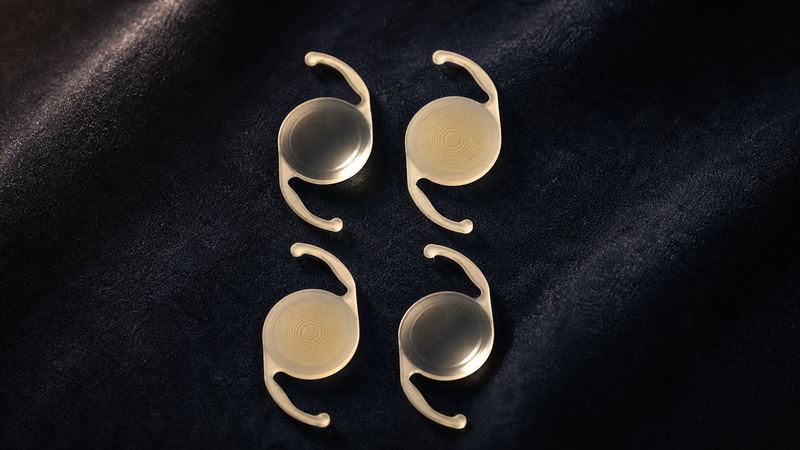
Now think about a window at night. When the glass is a very different material from the air, you see a reflection in it, and the bigger the mismatch between the two materials, the stronger the reflection. When we replace your natural lens with an artificial one, we're putting a polished, high-tech piece of acrylic where a water-like lens used to be, and that mismatch can make the reflection hundreds to thousands of times brighter than the natural lens.
Engineers measure this with the refractive index: how strongly a material bends light. The fluid inside your eye sits around 1.34, and your natural lens is close to that, but some artificial lenses are as high as 1.55, and the reflection gets disproportionately stronger as that gap widens. Interestingly, this has nothing to do with blue-light-filtering or UV-blocking tints; studies show tint makes no difference. It's the material and the shape of the lens.
Which lenses make my eye glint the most?
High-refractive-index acrylic lenses glint the most, and silicone and lower-index acrylic lenses glint the least. Before I name specific materials, one thing I cannot stress enough: the lenses at the top of this scale give superb vision, and surgeons implant millions of them every year for good reason. The overwhelming majority of those patients never think twice about a glint.
At the top of the reflection scale, with a refractive index of 1.55, are Alcon's AcrySof and its newer Clareon line, and Hoya's Vivinex. In lab testing, the AcrySof platform measured the highest external reflectance of any lens tested. In the middle are Bausch & Lomb's enVista at 1.53 and Zeiss's CT Lucia around 1.49. Noticeably dimmer is Johnson & Johnson's Tecnis family at 1.47, roughly half the surface reflection of the highest-index lenses. And nearly invisible are hydrophilic acrylic lenses like the Zeiss Asphina at 1.46 and silicone lenses, including the Light Adjustable Lens, at 1.43. That silicone lens reflects about one-fifth as much light as the top of the list.
Why surgeons still prefer the shiniest lenses
If low-glint lenses exist, why isn't everyone just using those? Because the shiniest lenses are shiny for a reason. High-index acrylic can be made incredibly thin, and that thinness is a big advantage, especially for higher-power and premium lenses like torics, where a lower-index material would have to be bulkier to hit the same prescription. A thinner optic folds down small and slips through a micro-incision, which can mean less induced warpage of the eye. These materials also hold a sharp square edge on the back of the lens, which acts like a dam against the cells that cause secondary cataract, and high-index acrylics have some of the lowest rates of that problem.
The low-glint materials aren't free lunches either. Hydrophilic lenses run thicker and have higher rates of secondary cataract, with a small documented risk of clouding years later. Silicone lenses, and remember that includes the Light Adjustable Lens, are amazing optically but come with their own surgical considerations. Tecnis is the compromise position: it's in the same high-index hydrophobic acrylic family as AcrySof and Clareon, so you keep most of the same advantages, the square edge, the low secondary cataract rate, the small incision, with about half the reflection.
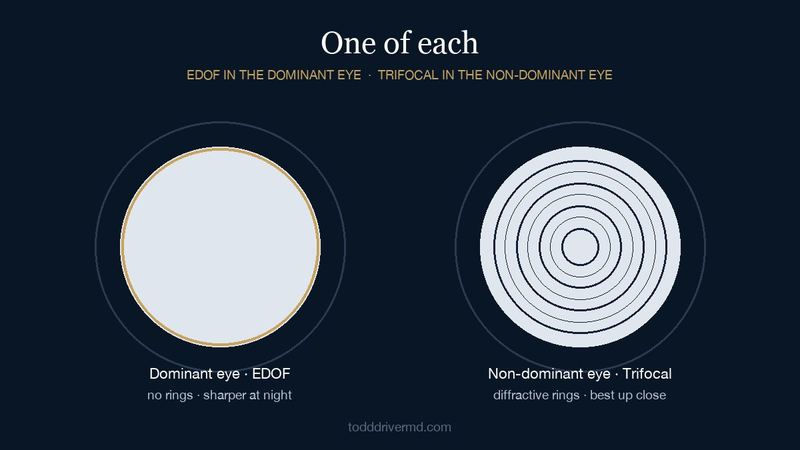
Lens shape matters too. A flatter front surface focuses reflections into a concentrated bright point, while a steeper front curve scatters the reflection so it appears dim and diffuse; two lenses with the same material can still look different in real life. And for premium lenses like multifocals and EDOF designs, the front surface shape is part of what makes the optics work. In some cases, a lens with a brighter reflection is genuinely the best choice for your visual goals.
Already had surgery? Two fixes
Option one, and the one I recommend first: glasses with a premium anti-reflective coating on both surfaces, in a larger or wrap-around frame. The glint is triggered mostly by light sneaking in from the side. Block that side light, and both the glint others see and the glare you experience calm down dramatically. Simple, safe, and effective.
Option two exists, but the caveat comes first: the lens can be exchanged for a lower-reflection design, and in published series that resolves or significantly improves symptoms in nearly nine out of ten patients. But it's a second surgery with real risks, so it's a last resort, and not something I recommend for cosmetics alone. Where it earns its place is when the glint comes with other real visual symptoms.
The two-question test
One: am I on camera, in photos, or in front of people enough that a visible flash in my eye would bother me? Two: when I hear that the shiniest lenses also have the thinnest profiles and the lowest secondary cataract rates, which side of that trade do I instinctively care about more? If your answer is "the glint would bug me," that's your cue. Say this to your surgeon: "I've heard some lenses reflect more light than others. Can we talk about the options?"
Quick recap: the cat-eye glint is a reflection off your artificial lens, purely cosmetic, and it doesn't touch your vision. High-index lenses like AcrySof, Clareon, and Vivinex glint the most and give phenomenal vision. Tecnis is dimmer; silicone and hydrophilic lenses barely glint at all. The shiny lenses earn their popularity with thinner profiles and fewer secondary cataracts. After surgery, anti-reflective glasses solve most cases without ever going back to the operating room. And the best time to prevent the cat-eye effect is before your cataract surgery in Irvine, with a conversation about what matters to you.
Related reading: all four cataract lens options compared · the Light Adjustable Lens explained · or cataract surgery in Irvine with Dr. Driver.
Two tools that may help you think this through: the 60-second lens quiz, and the vision simulator, which shows how each lens sees by day and at night.
Want a lens choice that fits your life, glint and all?
That conversation happens before surgery. Schedule with Dr. Driver at OC Eye Associates in Irvine.
Call (949) 653-9500Read next
This article is for educational purposes and is not a substitute for a medical examination or personalized medical advice.